


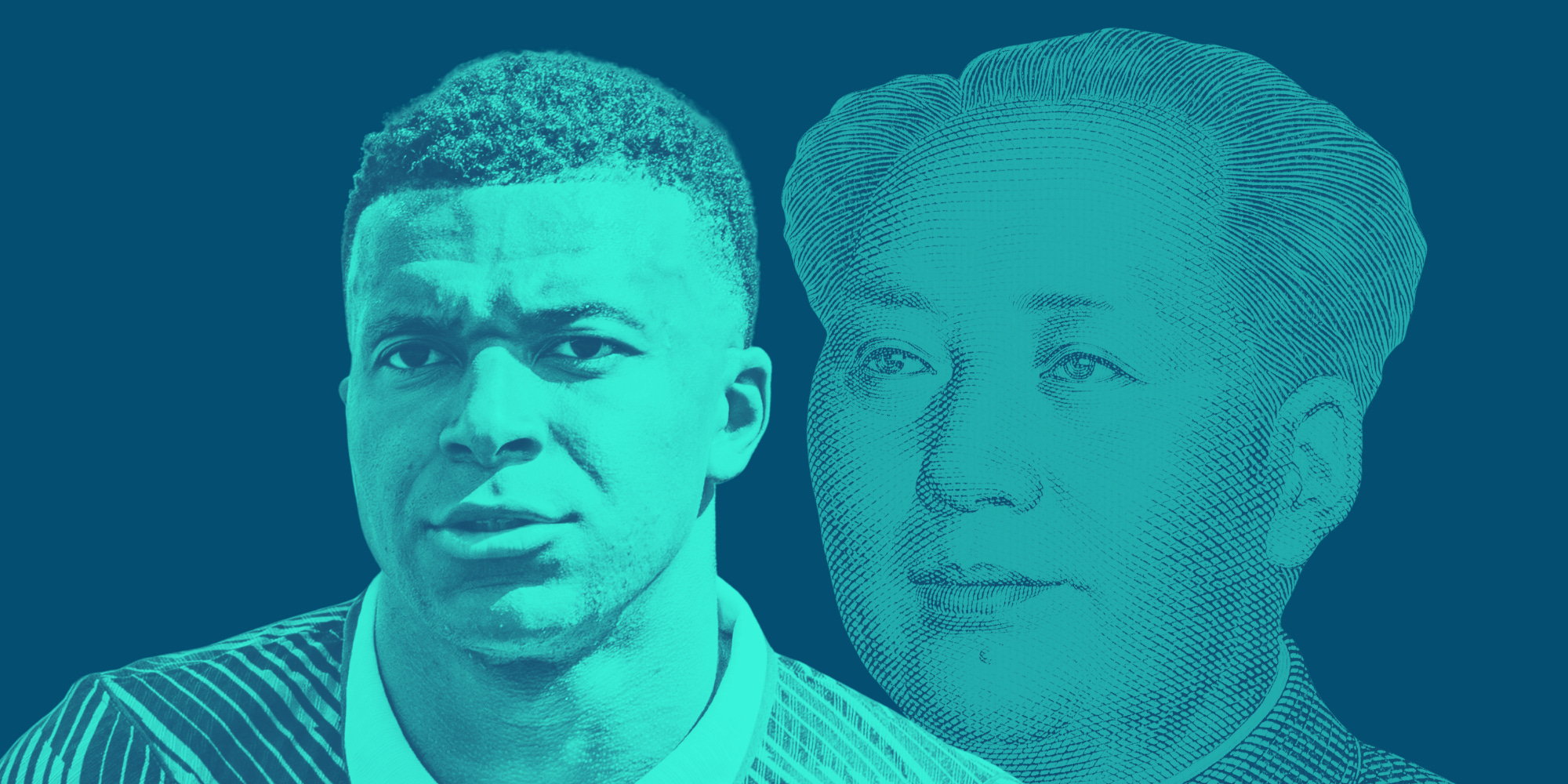

On a cursory glance, the latest controversy over French soccer star Kylian Mbappé’s remark about Mao Zedong, and the string of obsequious apologies that followed it, might seem like just that: an ideological controversy, a fight over claims of offensive speech, or an absurd blip in the endless string of culture wars.
But treating this as another eye-roll-inducing dustup would be a mistake. That’s because the fallout from Mbappé’s mild comment offers an insightful window into one of the most effective and widespread censorship campaigns today: the pervasive influence over how anyone, anywhere talks about China’s sensitive political issues.
Authoritarians control how they are spoken about in life. And, apparently, even in death.
Mbappé’s Mao misstep
It began, as it often does these days, with a viral video. In an interview, Mbappé said his favorite meme is “a video someone made of a guy…I think he was a Chinese dictator,” with Mbappé’s face superimposed on Mao Zedong’s body (fans have jokingly used the nickname “The Dictator” for Mbappé). French football podcast The Bridge, which posted the video, has since taken it down.
That’s all that happened. Mbappé didn’t even say Mao’s name.
But in reality, the details in these controversies don’t actually matter very much — neither does the context, the truth or falsity, or the intent. All that matters is that someone, somewhere, said something that runs counter to the Chinese government’s official political line.
Predictably, the punishment was sudden and severe. At least three Chinese companies canceled their brand sponsorships with Mbappé, each voicing their opposition to “any words and actions that hurt national sentiment.” State broadcaster CCTV cut streams of the Spanish professional football league La Liga and any games including Mbappé. China’s Ambassador to Spain, Yao Jing, met with La Liga President Javier Tebas to discuss whether the league could repair its many deals with Chinese partners after the insult.
“I am sincerely sorry.”
Swift apologies followed swift consequences. “My comment was ill-judged, and I now understand that it hurt many people in China and in Chinese communities around the world,” Mbappé said in a statement. “I have deep respect for the Chinese people and their history, and I am sincerely sorry.”
His team, Real Madrid, also issued a statement, offering “its apologies to the Chinese people for any discomfort caused by the recent words of our player Kylian Mbappé.” Further, Real Madrid “maintains a deep respect for China, its history, its culture and its citizens, as well as for the millions of Chinese fans who feel affection and admiration” for the team. La Liga, too, said it “deeply regrets the offence caused to Chinese fans by Kylian Mbappé’s recent comments.”
Chinese authorities have not even confirmed yet whether they accept the apologies.
It’s no mystery why organizations associated with Mbappé, and the athlete himself, are rushing to distance themselves from that remark: The financial punishments coordinated by the Chinese government and corporations can be harsh, long-lasting, and implicate a complex web of interconnected companies and organizations that risk retaliation in the fallout. Free speech can be quite expensive, in fact, and in this latest case, it’s already cost millions in lost sponsorships and deals.
Less than a decade ago, a similar saga unfolded after then-Houston Rockets General Manager Daryl Morey tweeted support for Hong Kong’s protests. The NBA lost hundreds of millions of dollars amidst the retaliation. Such stories have unfolded in other industries like gaming and fashion and, as I’ve written about for years, even in higher education institutions in democracies around the world.
If you want access to China’s market, you’d better, well, play ball.
This is about much more than just apologies and ‘hurt’
It can be tempting to see this as primarily a story of self-censorship, of groveling apologies for a mild remark about one of the most notorious figures of world history, and of insincere claims of hurt and offense as a means to shut up political speech. But the veins of real censorship run much deeper.
Even more telling than the Spanish league’s apology is the promise it made: “We are working with our partners and institutional counterparts in China to address this situation. Furthermore, in collaboration with clubs and players, we will introduce an awareness and communication protocol aimed at promoting respect for different cultures and helping to prevent similar situations in the future.”
There’s the root of it: La Liga suggests not just atonement for past expression, but an intent to limit the future speech of its athletes and clubs so costly comments don’t plague the league again. This is how threats of financial and other retaliation from abroad can encode censorship into the rules of organizations thousands of miles away. Will players be warned against privately expressing any opinion about any political matter that could upset fans — or government officials — somewhere? About Putin, or Trump, or Netanyahu, or Modi, or Xi?
What a victory for the Chinese government. And while those outside China rush to make amends over perceived political slights for their own financial benefit, those within the country suffer a much harsher fate just for speaking their minds about the very same subject.
Just look at Gao Zhen, a Chinese artist and U.S. resident sentenced to three years in prison in a secret, one-day hearing this year. Gao’s crime? Violating China’s Law on Protection of Heroes and Martyrs with satirical sculptures criticizing Mao — ones he crafted years before the 2018 law even passed.
What’s a self-serving apology for some is a jail sentence for others.
“Sleepless nights, tossing and turning, memories drift like clouds and smoke,” Gao recently wrote to his wife in a poem sent from prison. “Once a dragon slayer, now imprisoned, he has no regrets for mocking the wicked.”
Rather than offering groveling apologies, those outside China should reject these efforts to threaten and pressure while firmly asserting their right to “mock the wicked,” whoever they may be.
Sarah McLaughlin is Senior Scholar, Global Expression at the Foundation for Individual Rights and Expression and author of Authoritarians in the Academy: How the Internationalization of Higher Education and Borderless Censorship Threaten Free Speech.