


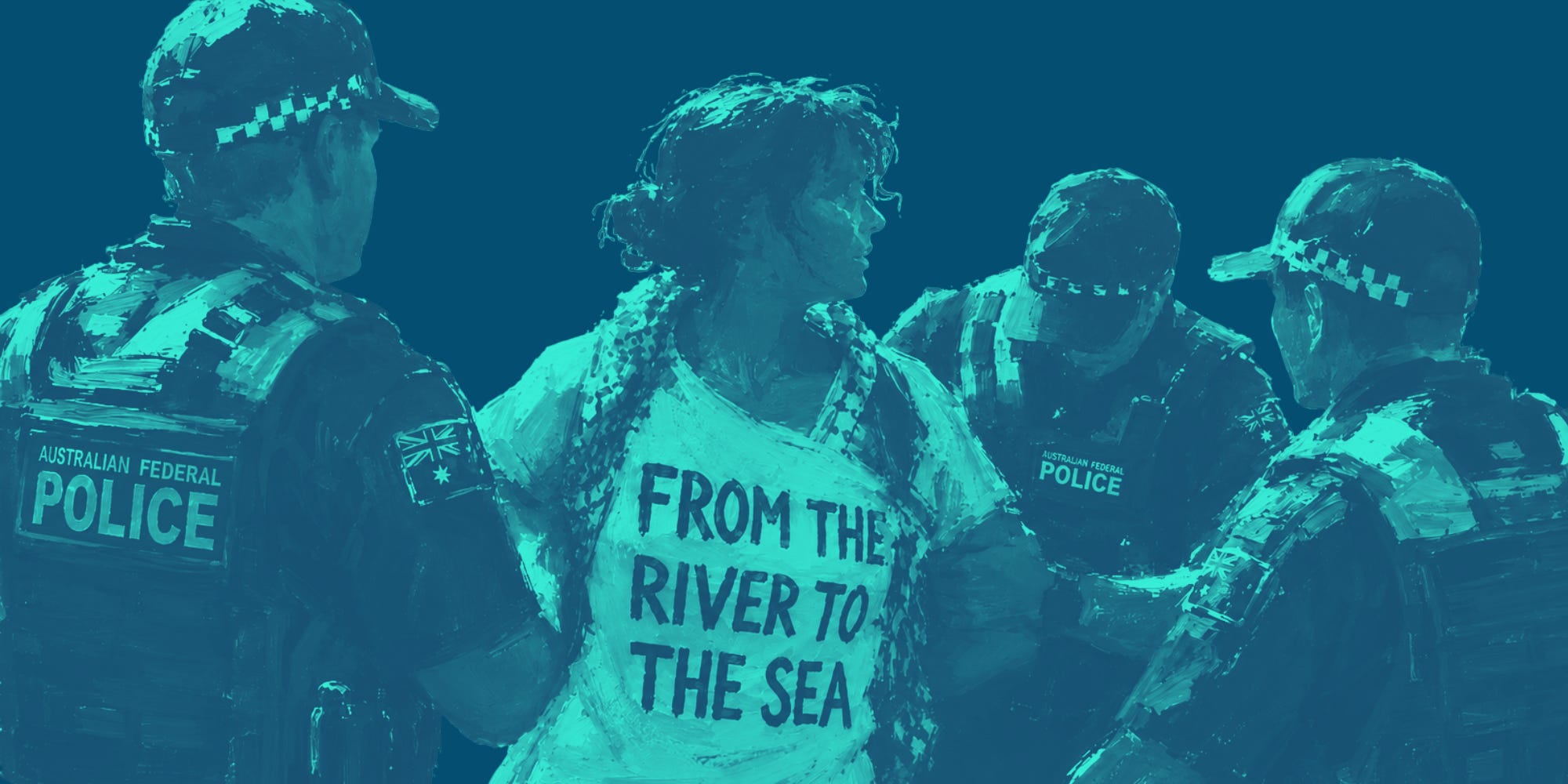
Australia might appear rather isolated when looking at a world map, but recent tragic events, such as the antisemitic Bondi Beach shooting, shatter the illusion of the country’s insulation from the world’s instability and conflict. Barbaric terror attacks like those that occurred at Bondi demand a government response, but it should not cause collateral damage to civil liberties. This, however, has been the case in New South Wales (NSW) and in Australia more broadly.
Sydney law professor and UN Special Rapporteur on counterterrorism, Ben Saul, put it bluntly: a 2025 NSW protest law made the state one of the most draconian anti-protest jurisdictions in the democratic world. In April, the NSW Court of Appeal struck down this protest law (“PARD scheme”) on the grounds that it impermissibly burdens the implied constitutional freedom of political communication. In recent weeks, NSW police have begun withdrawing charges made under the PARD scheme.
The Jarrett v. New South Wales constitutional challenge might seem like robust rights protection in action in Australia’s most populous state. However, I would argue it’s a symptom of the weakness of NSW’s human rights system and the state’s creeping illiberalism, especially regarding freedom of expression and assembly.
This stems both from the lack of a NSW (or federal) human rights act, and from the form of free speech protection under the Australian constitution (more on this below). Perhaps as a result, of all Australian states, NSW enacted the highest number of anti-protest laws between 2004 and 2024.
Australian Exceptionalism?
For context, Australia has traditionally viewed the common law and legislatures as the main guarantors of civil liberties. Instead of individual rights, its constitution deals largely with the structure and relationship of government. This might be surprising to international readers — especially in the U.S. — but similar systems operated in several British Commonwealth countries until the late 20th century.
However, Canada, New Zealand, the UK, and some Australian states have since enacted human rights acts/charters, having concluded that the old model of Commonwealth constitutionalism did not sufficiently protect rights. Nevertheless, important democratic concerns have been raised about granting judges greater power on human rights questions.
Unlike in many democracies, Australians have an implied freedom of political communication, not a personal, constitutional right to free speech (explained in Brown v. Tasmania). The implied freedom is a limit on legislative and executive power, not a right someone can assert directly or sue for damages over its violation. It applies to a narrower range of speech than expression rights in the US, UK, Canada, and New Zealand.
The NSW government’s disregard of protest rights when enacting the PARD scheme arguably created a pressure cooker that boiled over during the February 2026 visit of Israeli President Isaac Herzog. Using the PARD scheme, police restricted protests throughout Greater Sydney, including on the day of Herzog’s visit.
This “blunt tool” (Jarrett) not only ripped through the rights of expression and assembly, but it also seemingly emboldened the police to use disproportionate violence (currently under investigation) against protestors. One Sydney financier – a.k.a. “white shirt guy” – is now suing, alleging assault by police. More generally, this blanket ban removed the safety valve that peaceful protest provides in a democracy.
Social cohesion and Jewish safety were invoked to justify the PARD scheme and a new hate speech law in the state of Queensland. The Queensland law outlaws the phrases “from the river to the sea” and “globalize the intifada” (contextualized here; see charitable and critical interpretations of the slogan) when used to menace, harass, or offend someone.
Predictably, unintended consequences followed: Jewish pro-Palestinian activist Stephen Heydt was among the first charged under the Queensland law. This aligns with a pattern of censorship of pro-Palestinian Jews under hate speech and counter-terror laws, which The Future of Free Speech has documented.
Heydt’s crimes were that he wore a t-shirt to a Brisbane rally that said, “Jews for a free Palestine from the river to the sea” and gave a speech using the six-word phrase. In farcical scenes, protestors have recently sought to push the limits of the Queensland law by dancing in fancy dress en masse to an 80s ballad with very similar wording. This has faint echoes of the “Plasticine Action” and “Private Eye” arrests in England last summer.
Sharing Across The Kangaroo Route
Speech and protest laws Down Under have global implications, perhaps especially for the UK. As protest law expert Maria O’Sullivan argues, there has been some recent “swapping” between the UK and Australia on approaches to pro-Palestinian protest regulation.
Reports from Human Rights Watch, Netpol, and Justice have documented the effect of protest laws enacted in recent years in Britain. These share characteristics with Australian laws alleged to erode protest rights. The laws have enabled Australia and the UK to lead the world in arresting climate protestors.
Another similarity is the context in which further curbs on protest are being debated. Depressingly, there have been several recent antisemitic attacks in the UK, carried out by racists targeting longstanding British Jewish communities for the actions of Israel.
The most recent antisemitic attacks in the UK (and Bondi) have had implications for pro-Palestinian advocacy. Prime Minister Keir Starmer has said that he would consider banning some pro-Palestinian protests due to the “cumulative” effect, echoing new legislation, that they were having on some/most of the UK Jewish community. Decisions on specific marches in the UK are, however, ordinarily matters for the police under public order law.
Meanwhile, opposition political figures have called for a moratorium on all pro-Palestinian protests, calls echoed by the Independent Reviewer of Terrorism Legislation, Jonathan Hall. People who advocate for “intifada” or “death to the IDF” on protests now face being arrested and charged. Hall argues the “precautionary principle” in national security policy justifies some further restrictions on “open hatred on the streets,” which, in his view, has legitimized terror attacks on British Jews. However, perhaps counterintuitively, empirical research suggests that greater free speech is associated with lower levels of terrorism in democracies.
Among the above responses, it is possible to distinguish the Prime Minister’s slightly more nuanced approach from that of the opposition, which would most likely result in a disproportionate infringement of rights under the European Convention on Human Rights (ECHR). As a former human rights lawyer, Starmer should have in mind the obligations of public authorities, such as the police, under the UK Human Rights Act (HRA).
It is legitimate, and sometimes desirable, for authority figures to denounce the use of certain slogans on protests, such as “globalize the intifada.” This counterspeech and self-policing can also come from the self-professed antiracist organizers of the marches, which they would argue they do. However, when people are arrested for advocating “intifada,” it lowers the bar for censorship of political speech under UK and Australian law.
As Ben Saul points out, under international law, “globalize the intifada” and “from the river to the sea” are not intrinsically violent or hateful and are presumptively legitimate free speech, absent other indicators. Under English and ECtHR case law, there has traditionally been no right not to be offended. When discussing first principles, Jonathan Sumption sees criminalizing expressions of support for proscribed terrorist organizations in the same vein — an attack on the content neutrality of the law and a disproportionate infringement of free speech.
Conclusion
The direction of travel in Australia should serve as a cautionary tale for the UK and other countries. NSW, in particular, is a vivid reminder of what Conor Gearty witheringly called the fantasy of the civil libertarian common law. The English common law’s approach to freedom of expression was “hesitant and negative, permitting that which was not prohibited,” Lord Bingham summarized.
After the UK HRA came into force, it introduced new evaluative criteria, such as proportionality, for judges and other authorities with broadly positive implications for free speech and protest rights. While not a silver bullet, human rights laws generally “frontload rights-mindedness,” forcing greater consideration of rights ahead of any dispute. These considerations are perhaps in evidence in the comments of Prime Minister Starmer alluded to above.
In a 2018 lecture advocating for a federal human rights act, distinguished human rights expert Gillian Triggs concluded that “Australia has reached a position in which fundamental freedoms are diminished by a failure of the legal tools available to comparable countries.” Several other expert bodies in Australia have reached the same conclusion. Australia should chart a different course on free speech, protest, and its model of human rights protection.
Nick Queffurus is a law and policy researcher and consultant with interests in civil liberties and constitutionalism.