


This article was originally published on Jacob Mchangama’s Substack on September 11, 2026
This is the third installment of my series on Frederick Douglass’ free speech philosophy, drawn from the Frederick Douglass Free Speech Corpus, which is now live and freely searchable and even includes an audio player. The first installment examined Douglass’ defense of wartime dissent; the second, press freedom, defamation and journalistic ethics. Here I turn to the mobs that enforced slavery’s code of silence in the North and South—and to Douglass’ lifelong struggle against a form of censorship that survived emancipation. His insistence that using force to silence honest sentiments results in a “double wrong” remains a powerful message a year after the killing of Charlie Kirk and the wave of institutional and cultural censorship this political assassination unleashed.
The Sunday School Mob
When Frederick Douglass learned how to read on the streets of Baltimore, the speeches in the Columbian Orator gave “tongue to many interesting thoughts” that previously were mere flashes which “died away for want of utterance”. Douglass was eager to help pass on this newfound power to enslaved children at an improvised Sunday school in rural Maryland. But Douglass’ stint as a teacher was swiftly shut down by his own master and two Methodist lay leaders:
“we had scarcely got at work—good work, simply teaching a few colored children how to read the gospel of the Son of God—when in rushed a mob … who, armed with sticks and other missiles, drove us off, and commanded us never to meet for such a purpose again.”
Douglass was told he was trying to be a Nat Turner - the leader of a bloody slave revolt in 1831 - and was warned that if he persisted, “I should get as many balls into me, as Nat did into him”. A fifteen-year-old boy teaching illiterate children to read and understand the word of God was treated as an instigator of violent insurrection and threatened with death.
Douglass later acknowledged the twisted logic behind this strict proscription:
“The plea for this outrage was then, as it is now and at all times—the danger to good order. If the slaves learnt to read, they would learn something else, and something worse. The peace of slavery would be disturbed; slave rule would be endangered…. I do not dispute the soundness of the reasoning. It is perfectly sound; and, if slavery be right, Sabbath schools for teaching slaves to read the bible are wrong, and ought to be put down.”
This experience did not deter Douglass from successfully starting another and more clandestine Sunday school later on. But the brutal crackdown on the unshackling of the minds of Black children likely helped shape his lifelong opposition to what we might call “The Slave Power’s Veto”. This Veto would keep haunting Douglass even after he escaped slavery and supporters purchased his freedom. What Douglass called “Mobocracy” would even survive slavery and obstruct the efforts to ensure freedom, equality and voting rights to the emancipated.
The Veto Reaches Yankeedom
Though slavery rested on racial hierarchy and was concentrated in the South, the Slave Power’s Veto crossed the color line, and its tentacles reached far beyond the Mason-Dixon line and into Yankeedom.
In 1837, the white abolitionist editor Elijah Lovejoy was shot and killed while defending his printing press against a mob in Alton, Illinois. Two years earlier, the white theological student Amos Dresser had received twenty lashes on his bare back in Nashville, Tennessee, for possessing abolitionist literature and allegedly circulating it. A self-appointed vigilance committee ordered the whipping even though Dresser had violated no law. According to the local newspaper the Nashville Republican, Dresser should be grateful for this extrajudicial whipping, since only “the prudence and firmness of the Committee” had saved Dresser’s life from a lynch mob. That same year, Douglass’s future friend and mentor, William Lloyd Garrison, was dragged through the streets of Boston with a rope around his waist. In May 1838, the white abolitionist Angelina Grimké addressed an audience in Philadelphia’s Pennsylvania Hall as a mob hurled stones through its windows. The very next day, a mob burned the hall down.
In August 1845, a mob seized the printing press of the antislavery editor Cassius M. Clay in Lexington, Kentucky. Douglass repeatedly invoked these attacks to expose the Slave Power’s reach. He could think of “no occurrence of mobocratic violence against the anti-slavery cause which sent such a chill over my hopes” as the seizure of Clay’s press, which, operating in a slaveholding state, had been “a star shining in darkness, beaming hope to the almost despairing bondman.” But, he despaired, “the mob has triumphed, and the star apparently gone out.”
The mobs that Douglass faced down in person used methods of intimidation that ranged from heckling to violence. In 1842, The Liberator reported Douglass condemning racial prejudice for “exciting mobs against the colored people” and “preventing them from taking their places in society as equal members”. The Nantucket convention at which he spoke had itself faced people throwing brickbats and other missiles. In 1843, an abolitionist meeting in Pendleton, Indiana, nearly cost Douglass his life. A frenzied mob ordered the speakers to “be silent”, tore down their platform and attacked them. Douglass fought back with a stick before being beaten unconscious only to be saved by an intervening friend. Douglass’ broken right hand never fully recovered.
Salt-Water Mobocrats
Mobs not only attempted to prevent Douglass from speaking in churches, assembly halls, and outdoor meetings. He was even confronted with The Slave Power’s Veto on the Atlantic. In 1845, Douglass travelled to Britain on the steamship Cambria. American passengers threatened to throw Douglass overboard when he attempted to deliver an invited lecture on slavery. The captain’s threat to put the “salt-water mobocrats” in irons brought them to order.
The attack also demonstrated how suppression could backfire. The controversy was widely reported in the British press, which was much more hostile to slavery than in the United States. The Cambria affair introduced Douglass to a sympathetic British public eager to hear the man whom Americans had tried to silence. As we saw in the previous installment, his enemies sometimes became unwitting publicists for his cause. In a subsequent letter to the newspaper editor Thurlow Weed, Douglass exposed the double standard:
“But then, it will be said, the subject of slavery is not open to discussion. Who say so? The very men who are continually speaking and writing in its favor.”
The passengers had a right to ask about slavery, Douglass insisted, and he had a corresponding right to answer “so as to be understood by those who wished to hear”. Offending slaveholders could not extinguish either right.
In Britain, Douglass used his growing fame to expose how slavery corroded American liberty. Speaking in Paisley, Scotland, in 1846, he described the Northern states as “the tools of slaveholders”. A visitor from a free state could be “hung at the first lamp post” for proclaiming human equality in the South.
Yet abolitionists, quick to adopt modern communications technology, were making headway. More than a hundred newspapers now spread their doctrines, and speakers previously denied a meeting hall could take their arguments into the statehouse. Douglass and fellow abolitionists were once shunned by civil society, but “now we can hold meetings with men standing round to protect us.”
In Troy in 1855, Douglass placed “the suppression of all anti-slavery discussion” first among the Slave Power’s objectives. Its determination to silence opponents amounted to an admission of guilt: “Innocence has nothing to fear from discussion.”
The following year, in Rochester, he explained why free expression posed such a threat. Slaveholders understood that “the slave cannot be safely chained while the lips of freemen are unlocked.” Laws against abolitionist speech were reinforced by a public intolerance ready to erupt into violence:
“Look at the whole South. You have only to drop a word against slavery, to set a whole community in a blaze, and bring down upon you the violence of the mob.”
Free Speech for an Enemy
As in the previous installments, the harder test is whether Douglass extended his principles to his enemies. Did an antislavery crowd get a pass when it silenced a defender of human bondage?
Douglass’s defense of free speech extended to one of slavery’s most powerful political allies. In an October 1854 speech in Chicago, he addressed the recent shouting down of Senator Stephen A. Douglas (no relation and no ally), the architect of the Kansas–Nebraska Act. But before considering the senator’s grievances, Douglass described the people excluded from his promises of “Popular Sovereignty”:
Every right of human nature, as such, is denied them—they are dumb in their chains! To utter one groan, or scream, for freedom in the presence of the Southern advocate of Popular Sovereignty, is to bring down the frightful lash upon their quivering flesh. I know this suffering people; I am acquainted with their sorrows; I am one with them in experience; I have felt the lash of the slave driver, and stand up here with all the bitter recollections of its horrors vividly upon me.
This experience gave Douglass a particular obligation to exercise the freedom denied to those still enslaved:
There are special reasons, therefore, why I should speak and speak freely. The right of speech is a very precious one, especially to the oppressed.
He then turned to the senator’s wounded feelings:
“I understand that Mr. Douglas regards himself as the most abused man in the United States, and that the greatest outrage ever committed upon him, was in the case in which your indignation raised your voices so high that his could not be heard. No personal violence, as I understand, was offered him. It seems to have been a trial of vocal powers between the individual and the multitude; as might have been expected, the voice of one man was not equal in volume to the voice of five hundred.”
The mockery came with an explicit reaffirmation of principle:
I do not approve it; I am for free speech as well as for freemen and free soil.
Douglass recognized the senator’s right to speak while putting the interference he had suffered in perspective. Being drowned out by non-violent political opponents scarcely compared with the enforced silence of millions living under the lash. Yet the senator had no problem with systematic suppression when slavery was decided in elections where those wielding the whip cast ballots but those being whipped did not. Douglass could condemn the crowd’s conduct and ridicule the senator’s self-pity in the same breath. Indeed, he hoped the experience might teach the senator to respect the rights of those whose oppression he defended.
Douglass’s opposition to the heckler’s veto did not demand reverential silence from the audience. In 1862, Douglass gave a speech that viciously attacked both President Lincoln and General McClellan’s war efforts. A member of the audience got so vocally upset at Douglass’ remarks that he was about to get expelled and “handled roughly”, yet Douglass intervened and insisted that his critic be “heard patiently by the audience”. In Self-Made Men, Douglass observed that speakers could be as indebted “to the men who hiss, as to those who applaud”. Hostility could sharpen arguments and amplify a speaker’s message. Read alongside his denunciations of suppression, this suggests a distinction between opposition that leaves room for an answer and disruption that prevents a hearing altogether. Once again, Douglass resisted Milton’s Curse — free speech for me, but not for thee — while retaining the moral high ground and conceding nothing of his powerful argument.
A Mob of Gentlemen
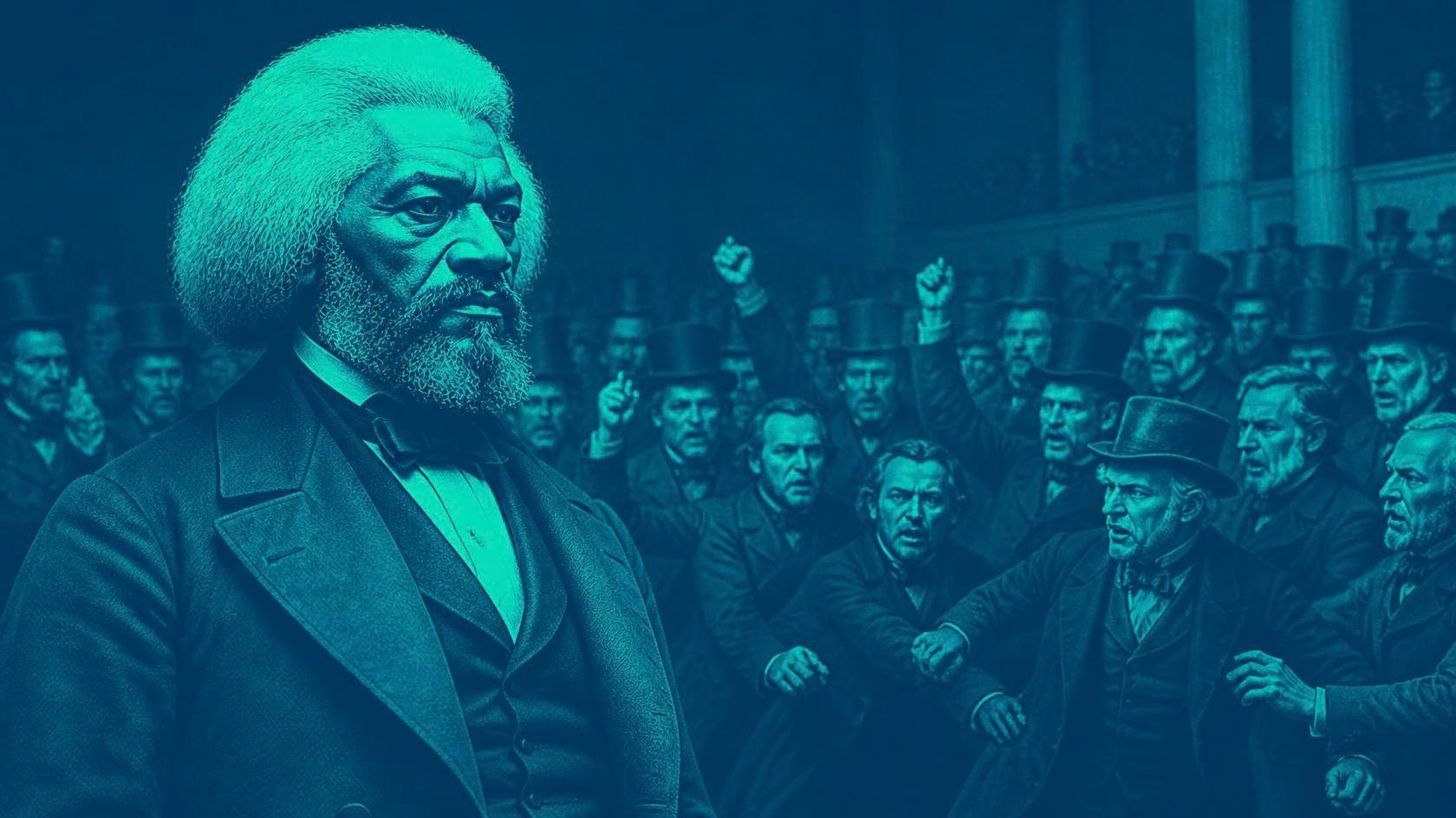
On December 3, 1860, abolitionists gathered at Boston’s Tremont Temple to commemorate John Brown and discuss how slavery could be abolished. A hostile crowd of Bostonians took over the meeting, which devolved into a fight in which Douglass gave as good as he received. Instead of protecting the meeting against the mob, the mayor ordered its dispersal.
Six days later, Douglass delivered his famous speech, A Plea for Free Speech in Boston, at the city’s Music Hall and aimed an accusatory finger at the Athens of America. Here was a city proud of its revolutionary heritage and supposed devotion to liberty. Yet the meeting had been captured by a “mob of gentlemen”—men who proclaimed their respect for law and order while trampling the rights of their opponents:
“Theirs was the law of slavery. The law of free speech and the law for the protection of public meetings they trampled under foot, while they greatly magnified the law of slavery.”
Douglass also confronted the more sympathetic observers who condemned the mob but regretted the meeting’s timing and choice of participants. Their advice would make the exercise of a right depend on the tolerance of those threatening it. Douglass insisted that “the time to assert a right is the time when the right itself is called in question”.
The protection of a handful of eminent speakers could not vindicate Boston’s freedom. The test was whether the same protection extended to the poor, the unpopular and the despised:
“There can be no right of speech where any man, however lifted up or however humble, however young or however old, is overawed by force, and compelled to suppress his honest sentiments.”
And the injury extended beyond the person on the platform:
“To suppress free speech is a double wrong. It violates the rights of the hearer as well as those of the speaker.”
This was the principle Douglass had defended aboard the Cambria, now expressed with exceptional clarity. A willing audience had rights of its own. The mob could not claim to speak for everyone present simply because it possessed the determination or physical force to overpower them.
As in his account of press freedom, Douglass’ understanding of free speech demanded more than the absence of censorship and suppression. It required institutions and a civic commitment capable of protecting the actual exchange of ideas in the public sphere. Officials who surrendered a meeting to its attackers helped make intimidation an effective instrument of censorship.
The Segregationist’s Veto
Emancipation would abolish the slaveholder’s legal ownership of other human beings. It would not abolish the power to silence them. In 1871, Douglass wrote an editorial titled “Liberty of Speech South” asserting that nothing had aroused the North’s “hatred” against slavery more than the South’s “absolute denial of the freedom of speech” on this topic. Yet, even after defeat Douglass claimed that Southern recalcitrants had “murdered not less than ten thousand loyal men” for exercising this freedom. His verdict on what was supposed to be a triumphant status quo was damning:
“until a man can express his opinion upon all possible subjects as freely and as safely at the South as he does at the North […] freedom is the merest farce, and reconstruction a failure.”
By 1878, Douglass lamented that “freedom of speech and of the ballot have for the present fallen before the shot-guns of the South”. The Slave Power’s Veto was becoming the Segregationist’s Veto: political violence could defeat the equal protection of rights and franchise that constitutional amendments had formally secured.
In Lynch Law in the South (1892), Douglass again looked beyond the men carrying out the violence. The “men who break open jails and with bloody hands destroy human life” acted on the public sentiment of the South created by “wealth and respectability, by the press and the pulpit”. The resemblance to Boston’s “mob of gentlemen” was unmistakable. Men did not have to wield a weapon themselves to help determine whose voice could safely be heard, when they could depend on the “ignorant mob” to do it for them with the promise of impunity from the state and approval from the public.
Two years later, in Lessons of the Hour, Douglass described the finality of the mob’s censorship:
“When the will of the mob has been accomplished, when its thirst for blood has been quenched, when its victim is speechless, silent and dead, his mobocratic accusers and murderers of course have the ear of the world all to themselves, and the world generally approves their verdict.”
More than sixty years separated this indictment from the dispersal of Douglass’ Sunday school. Progress had been made, but the dreams of true freedom and equality had yet to be realized. Despite Douglass’ herculean efforts, the mob’s infliction of the Double Wrong continued to sustain racial domination.
The Veto’s Afterlife
Fortunately, the Slave Power’s Veto has been soundly defeated; shot-guns no longer silence dissent in the South, nor do Southern sensibilities padlock lips in the North. Nonetheless, modern America has yet to fully internalize Douglass’ vision of a public sphere that cherishes free speech and cultivates tolerance of dissent as civic virtues.
A year ago, the conservative influencer Charlie Kirk was shot and killed while answering student questions at Utah Valley University. The reaction to Kirk’s assassination was not to double down on free speech. Instead it unleashed a “wave of censorship” at many American colleges, with faculty sanctioned for Kirk-related comments and students disciplined for what they posted. This points to a deeper problem of intolerance. According to FIRE’s most recent College Free Speech Rankings, 30% of college students say using violence is acceptable to prevent controversial campus speakers in some instances, 69% think shouting down a speaker can be justified, and 50% think blocking other students from attending a speech on campus can be justified. For the second year running, a majority of students opposed allowing each of six hypothetical controversial speakers on campus—three liberal and three conservative. Both sides have red lines they believe should be off limits, and both draw them from their own ideological and moral commitments.
College campuses are not the only arena where Mobocracy still lingers. Three months before Kirk’s murder, in June 2025, Minnesota’s former House Speaker Melissa Hortman and her husband Mark were shot dead in their home by a gunman specifically targeting Democratic lawmakers. In 2022 Salman Rushdie was stabbed on stage at Chautauqua by a religious fanatic offended by Rushdie’s 1988 novel The Satanic Verses.
Clearly, even today many are tempted to use force to compel fellow citizens to hide their honest sentiments. That was exactly what Douglass learned at fifteen, when his Sunday school was violently dispersed. Douglass saw clearly that the answer to violent intolerance was not to silence opponents in turn, but to preach and practice the principle of free speech. We would do well to follow his example today.
Jacob Mchangama is the founder and CEO of The Future of Free Speech and a research professor at Vanderbilt University. He is also the author of Free Speech: A History From Socrates to Social Media and The Future of Free Speech: Reversing the Global Decline of Democracy’s Most Essential Freedom (with Jeff Kosseff).