

Europe’s Maduro Moment
Spain seeks to adopt an illiberal playbook to crackdown on Big Tech.

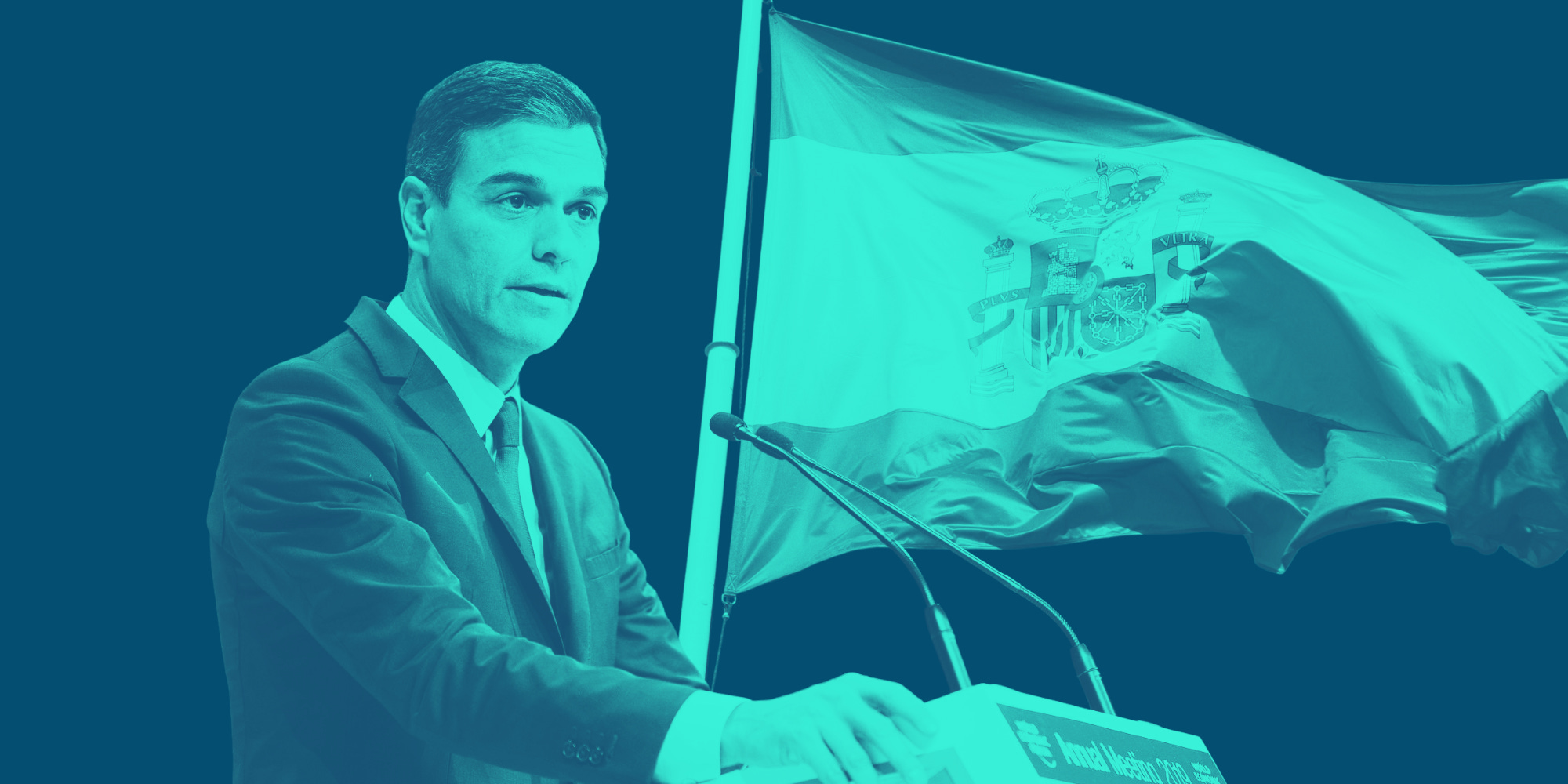
Democracies have long feared “Big Tech”—a shorthand for platforms that can spread hatred, disinformation, and extremism at scale. But I’m increasingly convinced Big Tech has also become a very useful villain for panicked politicians anxious about their inability to control public discourse in the digital age.
These days, almost any initiative—however coercive—can be packaged as a heroic defense of “democracy” and “digital sovereignty” (two concepts that until recently were seen as hard to reconcile) against evil tech oligarchs.
What’s more startling is how many people, media outlets, and civil society institutions cheer politicians who promise to “hold social media accountable,” without pausing to ask what that “accountability” actually means in practice.
Consider Spain’s Prime Minister Pedro Sánchez. In a recent speech, at the World Governments Summit in Dubai, he proposed ending anonymity on social media, holding tech executives personally criminally liable for “illegal” and “hateful” content, criminalizing certain forms of algorithmic amplification/manipulation of illegal content, and urging prosecutors to investigate platforms under a “zero-tolerance” posture.
On paper, the target sounds like tech billionaires like Elon Musk and Mark Zuckerberg.
In reality, the main target is the millions of ordinary users in European democracies who hold, share, and argue about immigration, Israel–Palestine, health policy, foreign policy, and other topics that make governments uncomfortable—especially at a moment of geopolitical uncertainty and anti-elitist electoral revolts.
Sánchez sounds convincing when he calls social media a “failed state” and paints democracy as the victim of foreign aggression. But make no mistake: if these proposals are implemented—and then exported across Europe, as he suggests—they would amount to one of the most serious crackdowns on free speech the continent has seen since the end of the Cold War.
Elon Musk’s views on European politics may well be ill-informed and highly partisan. But criticism of political decisions lies at the very heart of free speech. Framing such criticism as an “attack” on an “elected government” implies that once elections are over, the winners’ policies, priorities, and actions should be insulated from scrutiny—as if democratic legitimacy were a shield against dissent.
That is a distorted view of liberal democracy, where pluralism, argument, and sharp criticism are the lifeblood of self-government, and where “sovereignty” does not include the power to decide which ideas and information citizens may access or share. This principle is stated with exceptional clarity in Article 19 of the Universal Declaration of Human Rights:
“Everyone has the right to freedom of opinion and expression; this right includes freedom to hold opinions without interference and to seek, receive and impart information and ideas through any media and regardless of frontiers.”
In any case, Sánchez and his government are hardly powerless in the face of online criticism. They have abundant means to respond, rebut, and persuade. Sánchez’s own post featuring excerpts of his speech has attracted more than 1.8 million views on X alone, and it has been greeted enthusiastically by many users across platforms.
If anything, this is a reminder that governments are not helpless before social media—and that powerful politicians still enjoy an outsized megaphone. The real difference from the pre-social-media era is not that politicians have lost their voice, but that they now receive immediate feedback—often critical—from citizens, rather than enjoying the privilege of largely one-way, top-down communication to the masses.
It’s particularly disappointing that such proposals come from Spain—a country that knows what it means to live under stifling top-down censorship, and understands the difference between a population whose ideas and information are tightly controlled and a population allowed to think and speak for itself.
There’s also a glaring strategic contradiction. Europe rightly wants to supercharge innovation and build a vibrant European tech stack as an alternative to U.S. dominance. But how many startups will choose Europe if executives risk prison for failing to remove illegal content (a task that is not only difficult but often impossible if you also want to provide users with voice)? Would you provide a platform for users to engage in political speech if public officials effectively invite prosecutors to open zero-tolerance investigations whenever controversial content surfaces?
To truly appreciate how far democracies have gone down the road of censorship, compare Sánchez’s posture with the language used by (then) Venezuelan dictator Nicolás Maduro after his fraudulent win in the 2024 presidential election (via The Guardian):
“Elon Musk is the owner of X and has violated all the rules of the social network itself,” said Maduro… He alleged Musk had “incited hatred”.
Maduro also accused the social network of being used by his opponents to create political unrest.
Venezuela’s president said he had signed a resolution “with the proposal made by Conatel, the National Telecommunications Commission, which has decided to remove the social network X… from circulation in Venezuela for 10 days…”
Whatever you think about Elon Musk, no principled free speech champion himself, is this really the playbook that Europe wants to adopt?
Jacob Mchangama is the Executive Director of The Future of Free Speech and a research professor at Vanderbilt University. He is also the author of Free Speech: A History From Socrates to Social Media and The Future of Free Speech: Reversing the Global Decline of Democracy’s Most Essential Freedom (forthcoming with Jeff Kosseff).
The PSOE/PODEMOS coalition is notoriously heavy-handed in its approach to social change. Much of their feminist legislation over the past decade has been similarly carceral and biased against defendants. Like so many authoritarian policies carried out by European governments, it gets a free pass from liberal watchdog groups, as it's carried out under the aegis of "protecting human rights". Ironically, PODEMOS used to position itself as the libertarian socialist alternative to PSOE, but that went by the wayside once they got a little bit of power.