


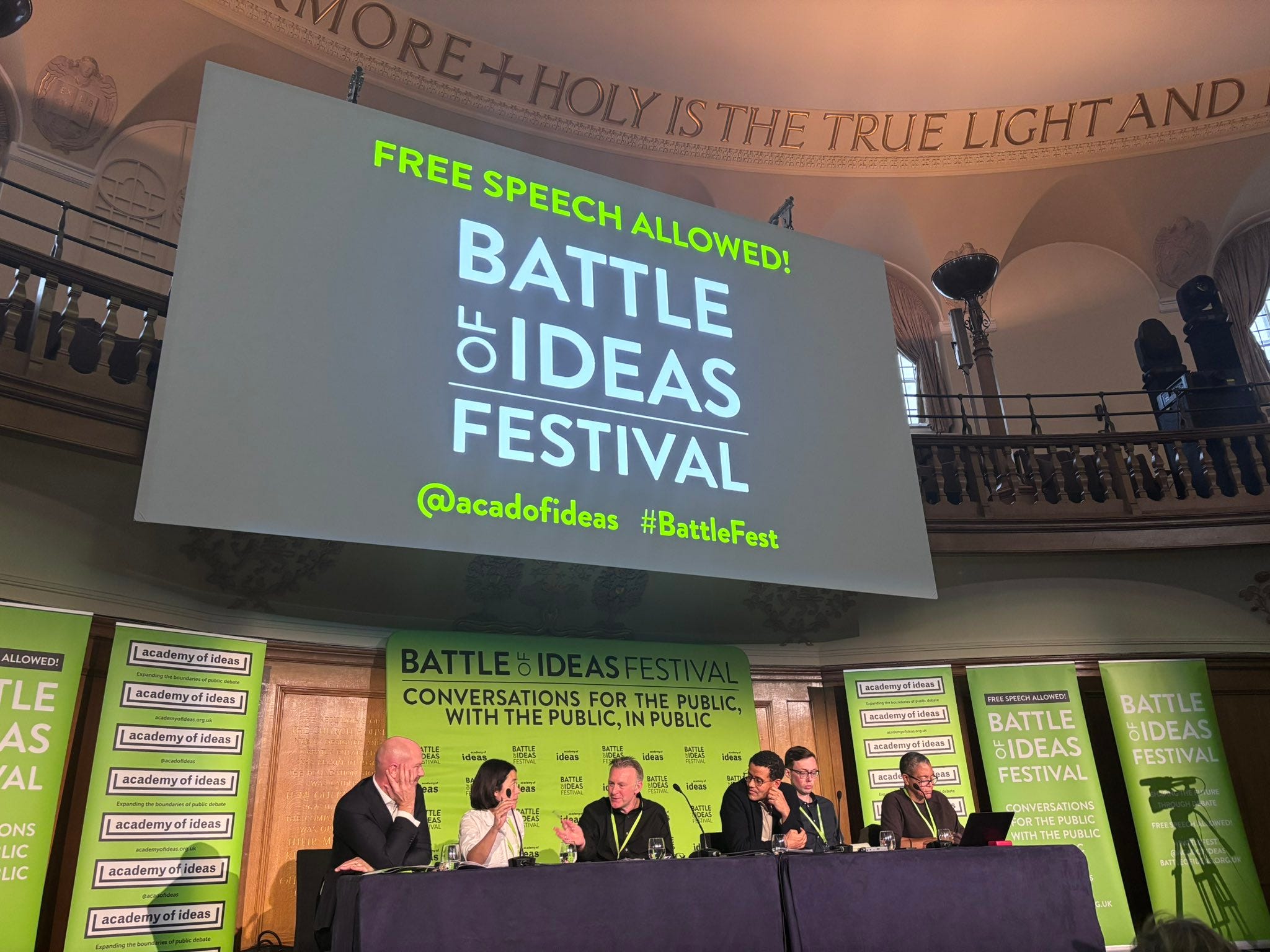
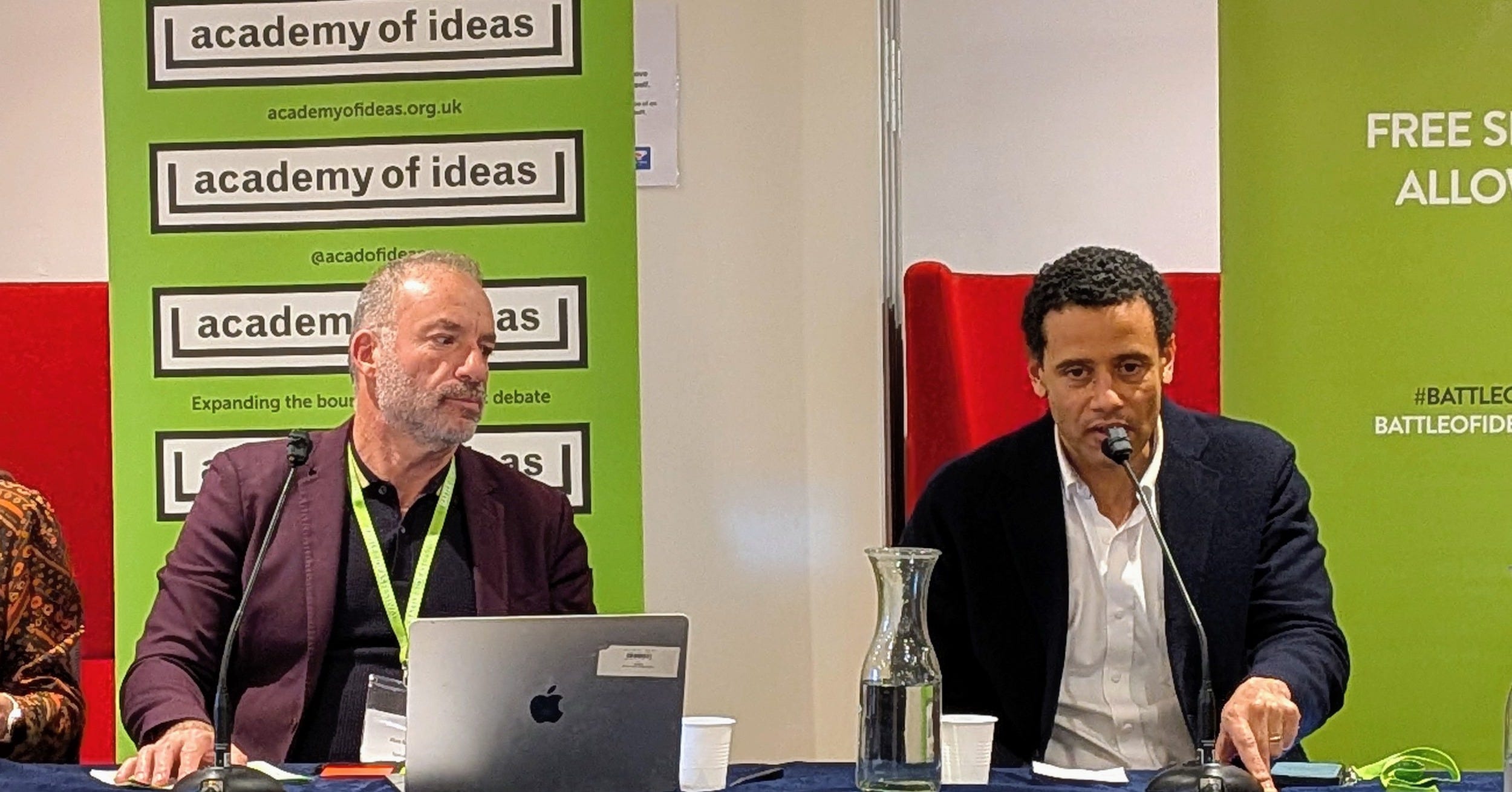
On October 18, I participated in a Battle of Ideas Festival debate in London titled “Free speech for me and not for thee? The red lines in free expression.”
The discussion addressed a familiar paradox: the politicians, commentators, and activists who passionately defend free speech when their own views are threatened often have remarkably little difficulty justifying censorship of their opponents. This affliction crosses ideological and partisan divides, and its roots stretch back centuries.
In Free Speech: A History From Socrates to Social Media, I called this phenomenon “Milton’s Curse,” after one of the most celebrated—and contradictory—champions of free expression in history. During the debate, I argued that Frederick Douglass offers a very different model: a universal commitment to liberty that refuses to distinguish between friends and enemies.
Below is a lightly edited and hyperlinked version of my remarks.
In 1644, John Milton published Areopagitica, one of the most stirring and eloquent defenses of press freedom ever written.
It’s a magnificent attack on prepublication censorship and a passionate defense of the pursuit of truth through open debate.
But read Milton a little more closely, and you discover that his commitment to free speech came with some rather significant ifs and buts.
Catholics, for instance, were not entitled to the same freedom. Nor did Milton believe that blasphemous or seditious publications should necessarily escape punishment.
And the ultimate irony?
Milton himself later worked as a government press licenser for the Commonwealth regime he served.
That’s why I call this phenomenon “Milton’s Curse”: the tendency to defend free speech passionately when it protects ideas we cherish, only to abandon those principles when confronted with ideas we loathe.
Almost four centuries later, Milton’s Curse is alive and well in Britain.
Let me offer a few examples.
Earlier this week, I debated a barrister at an event organized by the Free Speech Union.
We quickly discovered that we agreed on something fundamental: the government has no legitimate business policing opinions merely because they are offensive, hateful, or deeply unpopular.
We therefore agreed that Britain’s hate-speech laws should be repealed.
So far, so good.
But then we turned to Palestine Action, which the government proscribed under counterterrorism legislation in 2025.
Since then, thousands of protesters who have expressed support for the group have been arrested, many for simply holding placards. According to the Home Office’s latest figures, 3,630 arrests were linked to suspected support for Palestine Action in the year ending June 2026.
Here’s where our agreement on freedom of opinion suddenly evaporated.
According to my opponent, when the government decides that an opinion constitutes support for terrorism rather than stirring up hatred, suppressing it becomes not only legitimate but necessary.
“Terrorism” was the magic word that made censorship acceptable.
Never mind that the protesters merely supporting the banned organization may have no intention of committing or inciting terrorism and that their expressions of support are aimed at challenging government policy.
Of course, vandalism, violence and other criminal acts should be prosecuted.
But expressing a political opinion is not the same as committing or inciting a criminal act.
And this selective approach is hardly confined to one barrister.
Conservative leader Kemi Badenoch has forcefully defended press freedom and rightly criticized the arrest of Graham Linehan over his social media posts about transgender issues.
Yet earlier this year, Badenoch called for pro-Palestinian marches to be banned while defending the right of Tommy Robinson’s supporters to march.
Apparently, some protests are legitimate expressions of fundamental freedoms, while others are so dangerous that the government should prevent them from taking place.
But Milton’s Curse is by no means confined to the right.
Consider Zack Polanski, the leader of the Green Party.
Polanski has been one of the most vocal critics of the proscription of Palestine Action.
At the Green Party conference earlier this month, he condemned the arrests of peaceful protesters, invoked free speech and civil liberties, and demanded that the government drop the charges.
I agree with him.
But when Graham Linehan was arrested over his social media posts, Polanski defended it.
He told BBC Newsnight, “I think it was proportionate to arrest him.”
The police subsequently dropped the investigation, apologized and agreed to pay Linehan £25,000 in compensation.
Then, a few days after Cambridge professor Jason Arday resigned from his position, citing the “unrelenting level of public scrutiny” from media coverage over serious and well-documented accusations of plagiarism, he was found dead in his home.
Immediately following Arday’s tragic death, Polanski demanded greater government intervention against the press. His message was blunt:
And when challenged by prominent British journalist Andrew Neil, Polanski warned:
And change certainly came.
At this month’s Green Party conference, the party Polanski leads updated its platform in support of allowing regulators to force media organizations to cease operating if they failed to prevent racist or other discriminatory content.
The Greens even abandoned their previous categorical opposition to censorship of adult media and cultural activities.
So apparently, holding up a cardboard sign supporting Palestine Action is a fundamental exercise of free speech.
But arresting someone over controversial posts about transgender issues can be justified, while shutting down a newspaper for publishing material deemed discriminatory becomes a legitimate regulatory option.
For the barrister in my debate, “terrorism” was the magic word. For Polanski and his party, it’s “hate” or “racism.”
They’re distorted mirror images of each other. But both risk surrendering the same fundamental principle: That the government should not be able to suppress political opinions simply by attaching a sufficiently alarming label to them.
And those who cheered the suppression of their opponents may suddenly discover that the same powers are being used against themselves.
Every power you hand the censor to silence hatred today can be used to silence your extremism tomorrow. Every rule you write against terrorism today can be turned against your “disinformation.”
Welcome to Milton’s Curse, twenty-first-century edition.
And this goes to the heart of our wider problem.
The tendency to be outraged by the suppression of people and ideas we agree with, while ignoring or even celebrating the suppression of those we despise, poisons a robust, resilient, and principled conception of free speech.
It turns free speech into a political prop to be wielded for partisan and tribal purposes; a shield for our allies and a weapon against our enemies.
And the consequences are predictable.
We see them in Britain and across Europe today.
As research by The Future of Free Speech has documented, an ever-expanding collection of laws and regulations restricts speech deemed hateful, extremist, misleading, harmful, or otherwise unacceptable.
And instead of a principled public backlash, we get selective outrage.
But in a democracy, the ultimate beneficiaries of free speech are the people.
And the power politicians exercise to restrict that freedom ultimately derives from those very people.
We need to end this era of free speech LARPing. Because unless we abandon this tribal and partisan approach, the free-speech recession will continue and short-term partisan glee will eventually give way to long-term democratic woe.
Fortunately, we have another tradition to draw upon. In 1852, the great American abolitionist and orator Frederick Douglass warned that suppressing discussion of the rights of Black Americans would eventually endanger the rights of white Americans as well.
As I explored in my recent essay, “Douglass and the Betrayal of Freedom,” Douglass understood that we cannot safeguard our own liberty by allowing the government to suppress the liberty of others:
“If, to-day, these parties can put down the right of speech on one subject, to-morrow they may do so on another. If they can prohibit the discussion of the rights of black men, they may also, bye and bye, prohibit the discussion of the rights of white men.”
In other words, the freedom of our political opponents is inseparable from our own. And he distilled that universal principle into a few unforgettable words that should serve as the North Star for any serious defense of free speech:
“Liberty for all, or chains for all.”
Jacob Mchangama is the Executive Director of The Future of Free Speech and a research professor at Vanderbilt University. He is also the author of Free Speech: A History From Socrates to Social Media and The Future of Free Speech: Reversing the Global Decline of Democracy’s Most Essential Freedom (with Jeff Kosseff).
Great speech. I am sorry I had to miss it because I was speaking against government imposed social media age-gating in a parallel session! The examples you gave are excellent. I have many in Britain on the centre-right who see themselves as part of the "free speech movement" don't appreciate how much harm the UK Terrorism Act does to free speech.