


I’m broadly enthusiastic about AI, especially when it operates within a legal and cultural order grounded in freedom of expression and access to information. But books remain our most powerful technology for the deep immersion and long-term diffusion of ideas.
Content optimized for speed, virality, and short attention spans rarely matches the staying power of books. We are still reading and arguing with manuscripts written thousands of years ago. I doubt the Baby Shark dance video, despite its 16 billion YouTube views, will exert the same influence as Aristotle’s Politics two and a half millennia from now.
I am certainly no Aristotle, and I do not expect my work to survive into the year 4026. But books do travel farther, and last longer, than one imagines when writing them. What began as material for a podcast in 2017 became, in 2022, Free Speech: A History from Socrates to Social Media, which has been translated into Danish, Czech, Arabic, and Japanese, with more translations to follow.
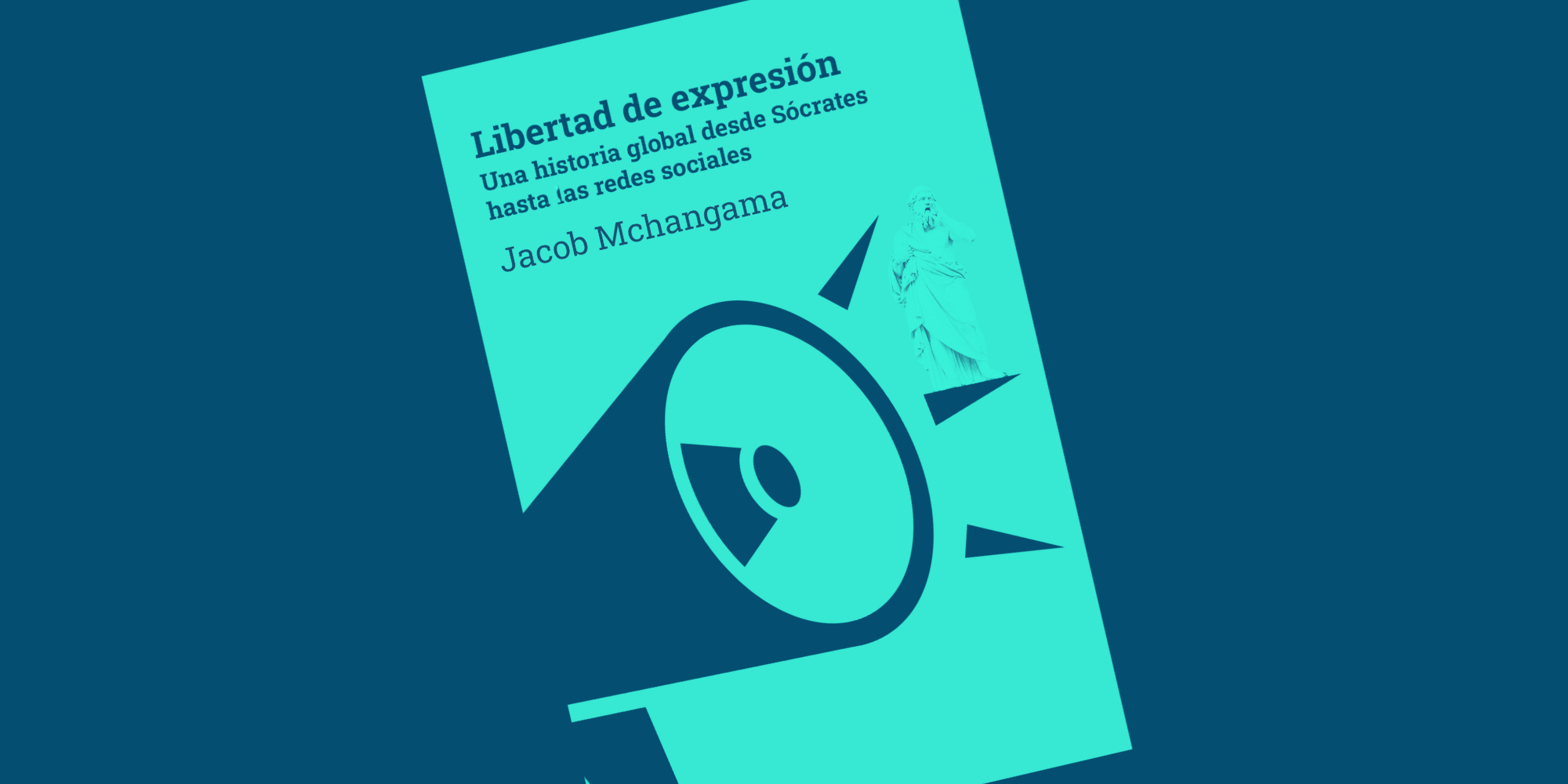
Today, I’m very pleased that the book is being published in Spanish as Libertad de expresión: Una historia global desde Sócrates hasta las redes sociales by Ladera Norte.
I’ve also been delighted to see Spanish writers and outlets engage seriously with its arguments, despite the book’s relatively limited treatment of the Spanish-speaking world.
Below are some translated snippets:
First, a column in ABC by Jesús García Calero:
We live in a volatile time, and it has become fashionable to organize summits against hate. Democracies are on the defensive, powerless to safeguard their principles, with the public sphere shattered by polarization and the arrival of a world without rules, where autocrats run rampant, and in which institutions are wounded and in question, from the UN on down. The implicit question is: who must be silenced, and why?
In recent days, the book Free Speech: A Global History from Socrates to Social Media, by Jacob Mchangama, published by Ladera Norte, has fallen into my hands. It is a striking work because it analyzes the problem from a unique perspective.
What is happening to us has already happened a thousand times; it is in the books. And the question is why we keep repeating failed strategies, the mistakes that dealt the final blow to the Roman Republic (the assassination of Cicero after the Philippics), to Weimar (which helped drive the rise of Nazism), or those that turned the Terror into one of the most enduring legacies of the French Revolution in the periods that followed.
ABC has also published an excerpt from the book:
To impose silence and call it tolerance does not make it so. Real tolerance requires understanding. Understanding comes from listening. Listening presupposes speech. By connecting past speech controversies with the most pressing contemporary ones, I hope to demonstrate just how much humanity has gained from the gradual spread of free speech—and just how much we stand to lose if we allow its continued erosion in this most recent digital phase of the age-old conflict between authority and free expression.
From Miguel Ángel Aguilar in 20minutos:
For this reason, the book Free Speech: A Global History from Socrates to Social Media, written by the Dane Jacob Mchangama and published in recent days by the publisher Ladera Norte, ought to be required reading….
With insight, Jacob Mchangama points out that the entropy inherent in freedom of expression, in addition to stemming from political causes, is rooted in human psychology, and that it is the urge to please, the fear of marginalization, the desire to avoid conflict, and the norms of courtesy that push us to silence uncomfortable speakers, whether on digital platforms, university campuses, or in cultural institutions. And he concludes that, for this reason, “it is of vital importance to actively foster and sustain a culture of respect for freedom of expression in order to ensure that it endures, given that laws alone are not sufficient.”
A column by Ricardo Cayuela Gally in The Objective:
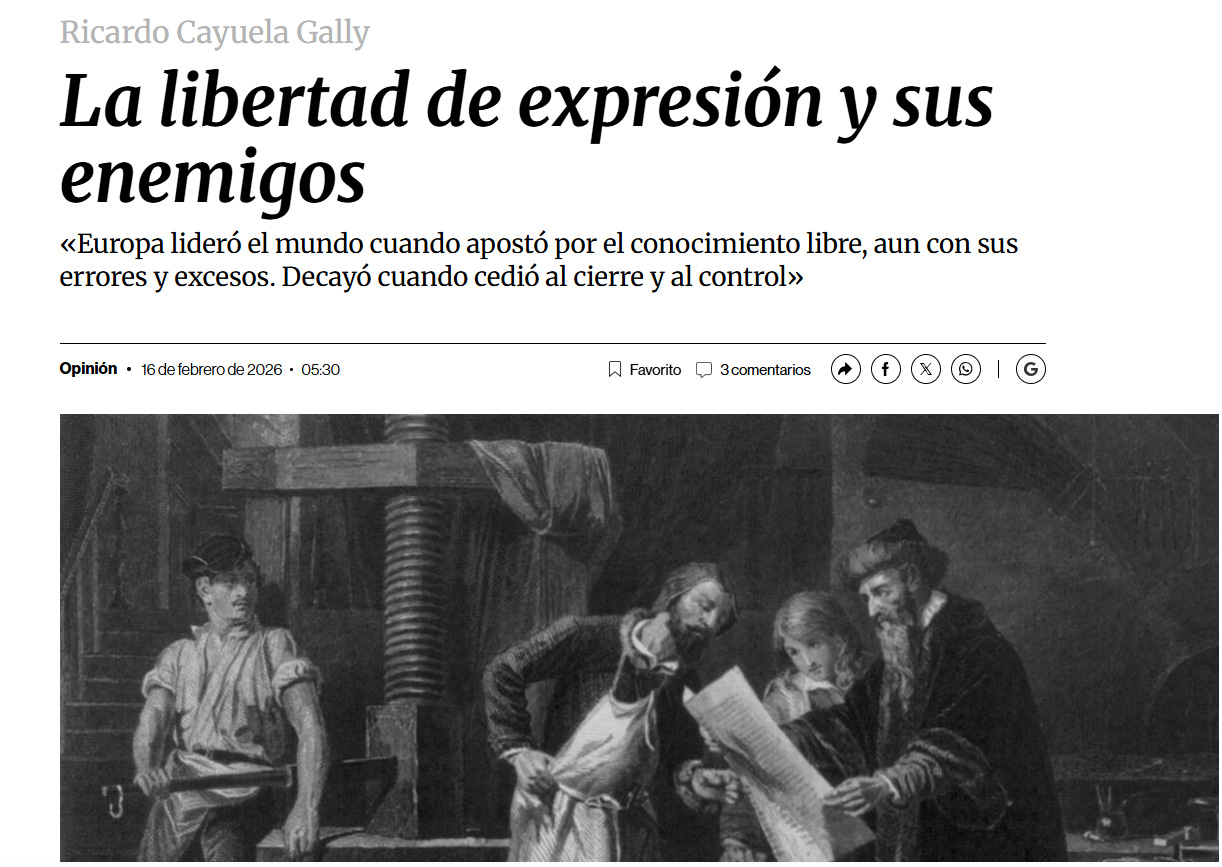
While Europe debated, printed, and engaged in polemics, the Ottoman Empire closed in on itself. The consequence was not stability, but progressive weakening and the loss of the larger historical contest with the West.
The Danish essayist Jacob Mchangama examines this episode in Free Speech: A History from Socrates to Social Media (which Ladera Norte will publish in Spanish, to return to the bias), where he describes the ‘panic of the elites’ in the face of a disruptive technology. In that same historical survey, he also analyzes what happened in the Weimar Republic, coining the expression ‘the Weimar paradox’ to explain how the restrictions adopted to defend democracy ended up facilitating its destruction.
And finally, here is an interview from last year with Alejo Schapire in the Argentinian magazine Seul:
There are many debates about the limits of freedom of expression, due to social media and polarization. However, as we can see in his book, much of this debate has taken place very similarly for centuries, especially with the arrival of the printing press. What is old and again in this debate?
The old is probably this dynamic of two conceptions of freedom of expression: one egalitarian and one elitist. One has its roots in Athenian democracy, the egalitarian conception, and the other is more typical of the Roman, Elitist republic, from top to bottom. The elitist conception of freedom of expression is very uncomfortable with the expansion of the public sphere through new communication technologies. So, when the public sphere expands, the traditional guardians, who are the ones who set the parameters of acceptable debate, fear that allowing new voices (mobs unfinished in the public sphere) will lead to the dissolution of society, its basic norms and values. It’s something we see over and over again.
There are many versions of this from the printing press. It happens very evidently with the Catholic Church, which is initially actually happy with the printing press, since it allows them to spread the good news faster. But suddenly, Martin Luther appears. And the Reformation uses the printing press and a very direct populist way, one could say, of communicating with the masses to fracture European Christianity. But it is also seen in the Enlightenment in France. The printing press was obviously a challenge to the Old Regime, as the thoughts of the Enlightenment became more and more prominent. And you see it now. It started with the telegraph and now you see a lot with social networks. In that sense, it is not a new dynamic as such.
Jacob Mchangama is the Executive Director of The Future of Free Speech and a research professor at Vanderbilt University. He is also the author of Free Speech: A History From Socrates to Social Media and The Future of Free Speech: Reversing the Global Decline of Democracy’s Most Essential Freedom (forthcoming with Jeff Kosseff).