


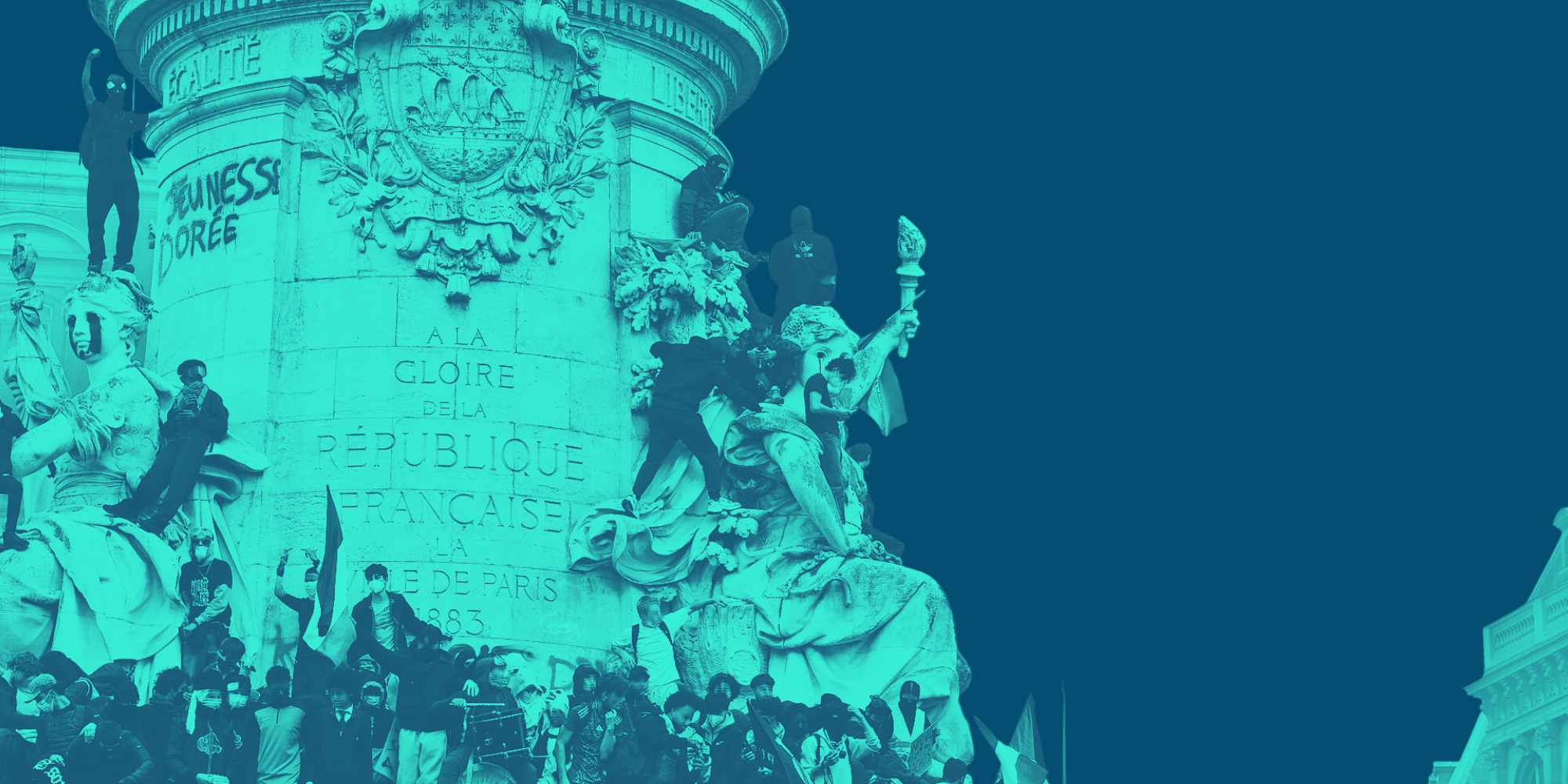

Now in their second month, French protests over the rising cost of living and deteriorating public education have spread to 40 cities nationwide. Government officials, meanwhile, are scrambling to respond, especially as some protests have turned violent and destructive.
But the struggle for control of the situation has not just been confined to on-the-ground clashes between protesters and police. French officials have also set their sights on exerting more control over the digital sphere, using many of the same justifications and tactics authoritarian governments deploy in the name of preventing “unrest” and maintaining “public order.”
According to a leaked letter from the French Prime Minister, the government asked the country’s four major internet service providers (Orange, SFR, Free, and Bouygues) to be ready to cut mobile access to TikTok, Instagram, and Snapchat in specific areas if demonstrations turned violent. France officials also met with representatives from six social media companies and online marketplaces, who were told to moderate protest footage and stop looted goods from appearing on their marketplaces.
But cutting off citizens’ access to social media and online spaces, especially when mass frustration boils over into organized action, not only denies access to information and thwarts mobilization of dissent — it can also shield disproportionate responses by authorities from public scrutiny.
One need only look to French history to understand the consequences of restricting citizens’ access to information in times of crisis.
In October 1961, a discriminatory curfew that targeted Algerian Muslims led to tens of thousands of protestors from affected communities marching peacefully through Paris in defiance of the restriction. The police response was brutal. Protestors were shot, beaten, and arrested en masse. In some cases, they were thrown into the Seine, where they drowned.
For decades, the French claimed the death toll was only three people and that police acted in self-defense, calling the protesters terrorists. The state falsified records, suppressed evidence, blocked investigations, and seized publications — burying the truth that a massacre led to 48, if not hundreds, of deaths.
It wasn’t until 1999 that French prosecutors agreed with that conclusion. It took until 2012 for the French Republic to acknowledge what historians have called “the bloodiest act of state repression of street protests in Western Europe in modern history.”
Imagine if social media existed in 1961. It would have taken four minutes, not four decades, for the truth to come out.
And yet, today’s French officials, pressured by populists on the right and left, continue to push for more top-down control of the public sphere, using methods borrowed from the authoritarian toolkits of states such as Iran, Belarus, India, and Russia.
France’s Push for Digital Control
“Today, when I look at our democracies, the Internet is much better used by those on the extremes,” President Emmanuel Macron said in 2018 in an address to the UN Internet Governance Forum in Paris. “It is used more for hate speech or dissemination of terrorist content than by many others. This is the reality, and we must face up to it,” he continued.
This perspective captures the French view of online space and the approach the country has taken since. By associating the Internet with threats to democracy, Macron has legitimized efforts to restrict it. This view has driven the country’s slide into digital authoritarianism.
In May 2024, during the deadly unrest in New Caledonia over changes to local electoral rules, the government declared a state of emergency. Not only did it deploy troops, but it also blocked TikTok, claiming the platform was spreading calls to violence. Despite a failed emergency legal challenge to lift the ban at the time, it was removed after about two weeks.
Almost a year later, on April 1, 2025, the Conseil d’État, France’s highest administrative court, ruled the ban unlawful, with caveats. It accepted that exceptionally serious circumstances might justify a temporary interruption, but found that a blanket ban with no defined end and no consideration of less restrictive options went too far. However, the ruling was not a shining defense of free speech. Instead, it argued that the Prime Minister at the time was justified in issuing a temporary suspension and in “recognizing the role of TikTok in the rapid spread of the disturbances due to the algorithms employed by the platform [....]given the lack of immediately available alternative technical measures.”
Of course, the impact on freedom of speech during the crisis in New Caledonia had already occurred. Moreover, the French government treated rulings like this as obstacles to overcome rather than instructions on how to protect fundamental rights in the future.
The latest attempt to clamp down on social media amid the current protests illustrates that the French government has not taken the impact on fundamental rights seriously since New Caledonia.
France Deploys Authoritarian Toolkit Amid Protests
Amid the current protests, the Prime Minister lacks the legal authority to order the country’s Internet Service Providers to cut mobile access to social media amid unrest, not to mention the technical difficulties of such a demand.
So the French Senate decided to approve an amendment that would let authorities order platforms to remove, within 24 hours, “content that directly causes the commission of voluntary harm to life, voluntary harm to the physical integrity of the person, sexual assaults, theft, destruction, degradation and deterioration, when these contents are likely to create a serious disturbance to public order.”
The amendment takes the incitement offenses defined in an 1881 press law, which courts normally decide, and allows administrative authorities, acting through Pharos, the Interior Ministry’s police reporting platform, to act as the judge instead. It extends a process built for Child Sexual Abuse Material, terrorism and similar content to speech they consider manifestly unlawful and “likely” to cause serious public disorder.
A platform or host that fails to comply faces blocking and removal from search engines, along with fines and prison sentences. The government first proposed a one-hour deadline to remove content that encouraged attacks on the state and insurrection, then softened it because of constitutional concerns. The Senate passed the whole bill the same night it was introduced, though it has not yet become law.
The problem with such a directive is that it entrusts authorities, especially during a time of uprisings and protests, to determine whether and what content has a direct causal relationship to violence and unrest. Further, when the same state apparatus whose conduct protestors may be exposing can determine what content can be removed, the threats to freedom of expression and the public’s ability to document events grow even greater.
Moreover, the technical tools for moderating content are far from proportionate. A geographically targeted block would prevent access to both calls to violence and legitimate documentation of violence. The 24-hour deadline with the threat of prison time incentivizes platforms to minimize risk and over-remove content without review. Smaller services could leave the country altogether.
None of the tools being deployed are unique to France. Many authoritarian and autocratic regimes use these techniques, especially during crises and uprisings. India imposes regional mobile Internet shutdowns and social media blocks. Turkey and Russia also throttle social media during unrest.
France’s rushed process mirrors the way Iran’s parliament in 2021 invoked an emergency constitutional provision to send a sweeping Internet bill to a small committee instead of a full vote. In 2022, that committee approved the bill in a session that lasted under 20 minutes. Like France, the Iranian government justified the bill as a measure to disrupt looting and violence. Tehran also claimed that online communications were being used to coordinate violence and threaten public order. Of course, France is not shutting down the entire internet, and its proposed social media restrictions are not as extreme. However, the justification and the timing of the government’s current efforts are disturbingly familiar: when unrest breaks out, authorities want to control the narrative.
But such measures would strip people of their main accountability mechanism. They complete a digital authoritarian toolkit à la française that the French government has been assembling for almost a decade: criminal exposure for platform executives, administrative blocking without a court order, and now a proposal to block platforms that fail to take down content, especially during uprisings, all under the guise of public order.
In 1961, nobody had social media to document in real time what the police did to the protesters. It helped the police to bury a massacre for half a century. Authoritarian regimes have long hidden violence the same way by restricting or banning online tools in times of crisis for years.
In New Caledonia, and again this fall, France is resorting to the same tools, showing us that democracies are not exempt from authoritarian impulses. When methods of online communication are restricted, especially during times of crisis, we should use the same scrutiny as if it were an actual authoritarian state.
Farzaneh Badiei is a Senior Research Fellow at The Future of Free Speech. Her work focuses on digital governance, unfettered access to technology, and human rights. She founded Digital Medusa to push back against tech determinism and defend a global, open, rights-respecting digital space.