


Originally published on my personal Substack.
Last week, a German man was fined 30 daily income units for calling Chancellor Friedrich Merz a “Lying Fritz” on Facebook. He was not alone. When the Heilbronn police published a Facebook post in October 2025 announcing the chancellor’s upcoming visit, some 400 comments rolled in — many mocking Merz, by then unpopular for breaking a string of campaign promises.
He was subjected to such indignities as “Ftzn Frieder” (roughly “c**t Freddie”), “Pinocchio,” and “Lackaffe” (”pompous fool”). Unfortunately for these keyboard warriors, Article 188 of the German Criminal Code punishes “Insult, malicious gossip and defamation directed at persons in political life” with fines or up to five years imprisonment.
Heilbronn police launched 39 investigations. The persons responsible for “Lying Fritz” and “Ftzn Frieder” were fined with 30 daily income units, “Lackaffe” escaped a formal conviction by paying a 100 Euro fine, while “Pinocchio” was deemed protected speech.
This was not an isolated incident. German newspaper Die Welt broke the story that Merz has used a private reputation firm to scan social media and report hundreds of insulting comments to the police since 2021, when Merz was the leader of the (then) opposition conservative CDU party in the Bundestag. Several of these complaints resulted in house searches with confiscations of phones and tablets, including one later deemed illegal and one of a severely disabled woman in a wheelchair.
Merz is not the only thin-skinned politician in Germany. From 2023 - 2025, the number of investigations for insults against politicians increased from 2,598 to 4,792, or roughly 85%. These cases often involve powerful government officials, such as the previous Vice-Chancellor and Interior Minister.
Article 188 was adopted in 2021 after the murder of a German politician by a white supremacist. Merz’s CDU colleague Carsten Müller defended the provision since “murderous acts followed bloodthirsty words.” But the idea behind punishing ordinary citizens for sarcastic, offensive, and insulting statements about their elected officials goes well beyond incitement and threats. Its purpose is to prevent “attacks on personal rights” as well as on “political discourse in the democratic and pluralist social order.”
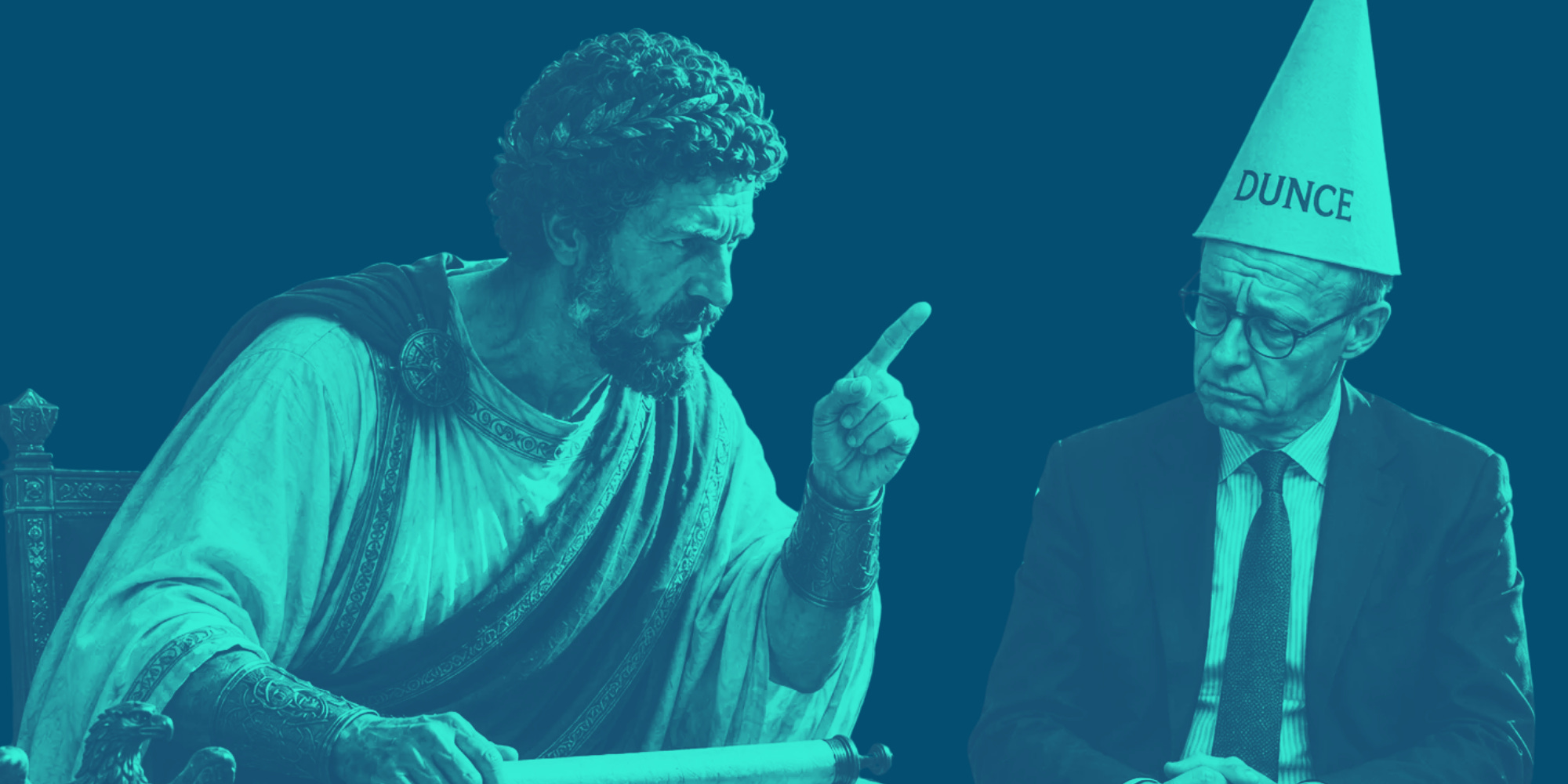
Ironically, an unelected Roman emperor who held vastly more political power over his subjects than Germany’s democratic leaders hold over the citizens from whom they derive their power would have rejected Article 188 and its rationale as both unjust and unwise.
Almost 2,000 years ago, the Roman emperor Marcus Aurelius wrote his famous “Meditations” (Hays translation), a timeless manual on how to apply Stoic philosophy to practical life. Aurelius is often referred to as a “philosopher king.”
But Meditations is not an abstract theoretical work of philosophy. It was written for an audience of one, Aurelius himself, as a form of philosophical self-help guide while he was fulfilling his duties on military campaigns, navigating treacherous revolts and trying to hold the empire together during deadly plagues.
Despite ruling the most powerful empire on earth and wielding unchecked power over millions of subjects, Marcus Aurelius has a lot to say about the value of free speech, criticism, and the tolerance of insults, mockery, and hatred, which contrasts sharply with the democratically adopted laws that protect elected government officials like Merz.
In Book I.14, Marcus pays respect to his mentors and teachers for instilling basic values in him, including the ideal of:
a society of equal laws, governed by equality of status and of speech, and of rulers who respect the liberty of their subjects above all else.
Marcus uses the Greek terms “parrhesia” — uninhibited or fearless speech — and “isegoria” — equality of (political) speech — concepts central to the Athenian democracy that was the epicenter of the very Greek philosophy that Marcus Aurelius consumed.
Contrast this with the German prosecutor who insisted that it was necessary to punish the Facebook post calling Merz a Lying Fritz because it was:
shaking confidence in the integrity of the victim, because it was capable of stirring up further negative prejudices or even aggression among like-minded individuals.
But for Aurelius, the values of free and equal speech were not so much about institutional safeguards or laws — the Roman empire had no bill of rights — as about ethics and cultivating the mental habits necessary for leading a virtuous life.
Marcus was surrounded by courtiers and flatterers, and many people he met would have been afraid to criticize him. There had traditionally been very good reasons for this, given the harsh treatment that Emperors like Tiberius dished out to people whose words and writings displeased them and who transformed Republican Rome’s relatively lenient attitude towards political criticism into the capital crime of “literary treason.”
Yet, Marcus entirely rejects the idea that he — or any other prominent figure — is different from other men, or in need of special protection. In fact, he welcomes criticism as set out in book VI.21:
If anyone can refute me—show me I’m making a mistake or looking at things from the wrong perspective—I’ll gladly change. It’s the truth I’m after, and the truth never harmed anyone. What harms us is to persist in self-deceit and ignorance.
It’s no surprise that John Stuart Mill - who regarded Marcus Aurelius “the best and most enlightened among his contemporaries” - would adopt and elaborate this argument in On Liberty some 1,700 years later.
Merz and the German political establishment might retort: We too value debate and pluralism and will heed constructive criticism, yet we draw the line at gratuitous insults that contribute nothing to serious discussions and are solely aimed at degrading the dignity of public officials and undermining democratic institutions.
Yet, Marcus Aurelius’s ethics is much more demanding than merely embracing reasoned criticism. Again and again, he reminds himself that humans are imperfect and hold conflicting ideas about the highest good, with each person convinced that they are in the right and others wrong. Accordingly, insults and expressions of hatred are a natural consequence of ignorance and pluralism, which cannot be remedied by punishment or responding in kind with anger and hatred.
When possible, a virtuous person should try to reason and correct those who are misguided. When this is not possible, a virtuous person should strive to look at words for what they are: words. Aurelius’ central insight is that insults and hateful words only hurt if you allow them to. If you train your mind not to slavishly identify with others’ opinions about you, but evaluate them as objectively as possible, you’ll not be afflicted by feelings of rage, anger, hatred, or sorrow that offensive words can provoke in the reactive mind. This quote from Book VIII.48-49 is instructive:
The mind without passions is a fortress. No place is more secure. Once we take refuge there we are safe forever. Not to see this is ignorance. To see it and not seek safety means misery. Nothing but what you get from first impressions. That someone has insulted you, for instance. That—but not that it’s done you any harm.
And he goes further:
Someone despises me. That’s their problem. Mine: not to do or say anything despicable. Someone hates me. Their problem. Mine: to be patient and cheerful with everyone, including them. Ready to show them their mistake. Not spitefully, or to show off my own self-control, but in an honest, upright way.
In light of Marcus Aurelius’ wise insights, Merz’s reaction becomes almost laughable and pathetic. Should the Chancellor of Germany really be concerned about random insults on a Facebook post? In what concrete way can such comments hurt the most powerful man in Germany? Should the leader of a country struggling with a flagging economy, integration of immigrants, and a disintegrating NATO, not be robust enough to laugh at personal insults, rather than treat them as threats to the government he heads? If Merz believes that the people in whose name he governs are wrong about his policies, why not try to listen, understand, and correct their views, rather than have the police show up at their doors?
Marcus Aurelius also appreciates the benefits of tolerating the value of humor in the form of sharp and sarcastic personal attacks. He specifically praises the Old Comedy of Athens, often associated with Aristophanes, who ridiculed prominent Athenian politicians, intellectuals, and even the Gods. From Book XI.6 (Long translation):
After Tragedy the Old Comedy was introduced, with its magisterial freedom of speech, and by its very plain speaking reminding men not to be insolent.
In other words, the emperor of Rome actively embraced the value of satire in reminding the powerful that they, too, are mere humans and that arrogance and self-importance are vices to be kept in check, not to be indulged or protected through force.
It would be wrong and ahistorical to portray Marcus Aurelius as an early champion of liberal democracy or human rights. He was, after all, an emperor; there were persecutions of Christians during his reign, and he fought bloody campaigns to retain the empire that his predecessors had conquered through brutal wars. For these failings, Mill explicitly uses Marcus Aurelius as both an aspirational figure for cultivating an open and tolerant mindset and as a tragic warning against believing oneself to be beyond reproach:
Unless any one who approves of punishment for the promulgation of opinions, flatters himself that he is a wiser and better man than Marcus Aurelius--more deeply versed in the wisdom of his time, more elevated in his intellect above it--more earnest in his search for truth, or more single-minded in his devotion to it when found;--let him abstain from that assumption of the joint infallibility of himself and the multitude.
Mill’s challenge applies with full force to Germany’s prosecutors and legislators: do they flatter themselves wiser and better than Marcus Aurelius? However imperfect his rule, it is difficult not to conclude that the ethics this ancient emperor strove to live by were far more conducive to liberal democracy than the cognitive dissonance underlying modern Germany’s speech crimes, where the powerful enjoy special protection against criticism from their own citizens.
Several politicians have argued for the repeal of Article 188 and the end of mass investigations of citizens who throw rhetorical daggers at their politicians, but so far to no avail. Perhaps Germany needs a “philosopher Chancellor.”
Jacob Mchangama is the Executive Director of The Future of Free Speech and a research professor at Vanderbilt University. He is also the author of Free Speech: A History From Socrates to Social Media and The Future of Free Speech: Reversing the Global Decline of Democracy’s Most Essential Freedom (with Jeff Kosseff).