


.jpg)
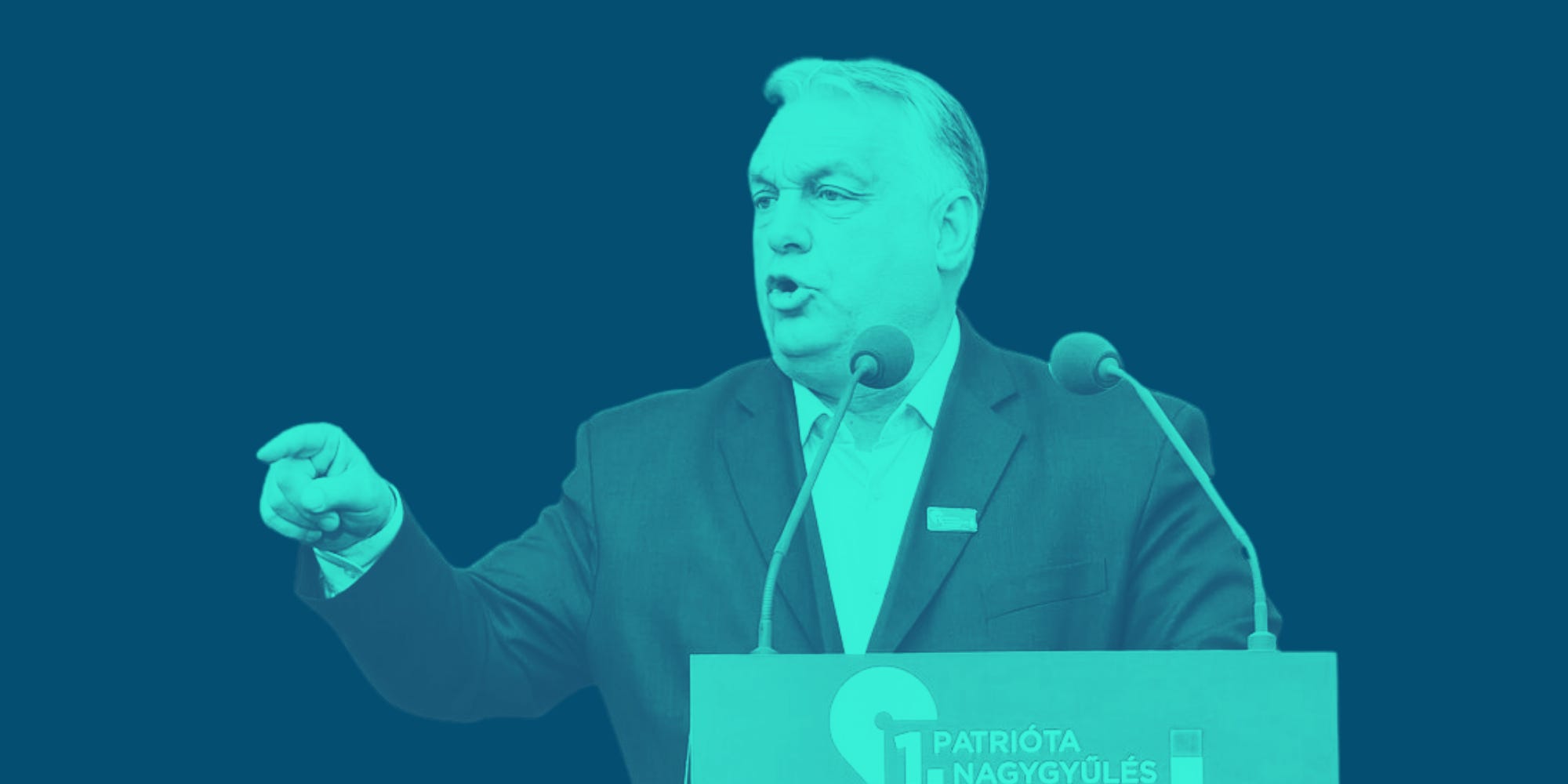
J.D. Vance criticized European democracies for censorship — but praised Viktor Orbán for sharing American values, including on free speech. Many on the right agreed.
But did Orbán actually support free speech, or were his critics right? Here is the record, year by year.
2010–11: Packing the Media Council
After winning a supermajority, Orbán packed the Media Council with Fidesz loyalists who could fine outlets for vague “content violations,” deny licenses, and steer state advertising to friendly media. More than 1,600 journalists were purged from public broadcasting. From Human Rights Watch:
After Fidesz won the 2010 elections, the government started to seize control of the media. It used its two-thirds majority in parliament to overhaul the media law, and packed the Media Authority, the media regulator, and its and Media Council with Fidesz loyalists. The government fired over 1,600 journalists and media workers at the public service broadcaster (MTVA), replacing them with government talking heads, effectively turning MTVA into a government-controlled broadcaster. Current and former MTVA employees told Human Rights Watch that reporters are told by their editors what and how to report, and which terms to use and to avoid, and if they do not like it, that they can pack and leave.
October 2016: Népszabadság Shut Down Overnight
Hungary’s largest opposition daily, Népszabadság, was closed overnight, days after publishing corruption stories about Orbán associates, suggesting political pressure. Fidesz’s vice president said, “It was about time.” The New York Times reported:
But on Saturday, [Investigative reporter Roland] Baska found that he could access neither his work email nor the newspaper’s website, including its archives. Mediaworks, the parent company, had replaced the website of the newspaper, Nepszabadsag, with an announcement that it was suspending publication immediately, because of steep circulation losses over the last decade.
Mr. Baksa and many of his roughly 50 colleagues, whose jobs are now in limbo, suspect another motivation: interference from the government of Hungary’s populist, right-wing prime minister, Viktor Orban, which has reined in government-run media and appears to be wielding increasing influence over privately run news companies as well.
In the newspaper’s final week, it reported that the head of Mr. Orban’s cabinet office had flown to a celebrity wedding by helicopter — an exorbitant expense that he had initially denied. The same week, Mr. Baksa revealed that the governor of the central bank was living in a luxury apartment owned by the president of the Hungarian Banking Association. Earlier, he had reported on the governor’s romance with a young woman who was consequently hired by the central bank for a record salary.
The paper was ultimately acquired by an Orbán-linked businessman.
April 2017: Lex CEU
A law written to target exactly one institution — the Central European University — gave the government sole discretion over agreements CEU needed to operate. CEU was forced to move to Vienna. The EU Court of Justice ruled the law illegal — too late, according to the BBC:
Europe’s top court has ruled that Hungary broke EU law when education rules forced a university in Budapest to shift most activity abroad.
The 2017 law focused on foreign universities but singled out the Central European University (CEU) founded by George Soros.
The European Court of Justice said that conditions imposed by Viktor Orban’s government were incompatible with EU law.
Only a skeleton CEU staff remains.
The central Budapest campus is now largely empty, after the law forced the university to move more than 90% of its teaching to a brand new campus in Vienna at a cost of €200m (£180m).
2018: KESMA — 500 Outlets, One Holding
Roughly 500 media outlets — TV, radio, newspapers, news websites — were simultaneously “donated” into a single government-aligned holding called KESMA. Orbán personally exempted it from competition law as a “national strategic interest.” By 2019, an estimated 80% of Hungarian media was under Fidesz control.
KESMA was soon to become the centralized media hub for media aligned with Fidesz, the party of Hungary’s prime minister, Viktor Orbán. It would provide a vessel for the government to exercise indirect control over much of Hungary’s private media landscape.
[ . . . ]
In December of 2018, the Orbán government decreed the formation of the KESMA conglomerate a matter of “strategic national importance”, thereby enabling KESMA to evade an investigation by the competition authority over antitrust rules.
By then, an investigation by a Hungarian news outlet estimated that KESMA controlled close to 500 media outlets.
March 2020: The Pandemic “Fake News” Law
Orbán’s emergency pandemic law — passed with no sunset clause — criminalized spreading “fake” or “distorted” facts about COVID, with up to five years in prison.
On Wednesday a member of the Momentum opposition party was detained in southern Hungary, over a social media post about a controversial government policy of clearing non-virus patients out of hospitals to make beds available for COVID-19 sufferers.
János Csóka-Szűcs shared a post from opposition MP Ákos Hadházy, adding that 1,170 hospital beds in his town of Gyula were being cleared -- a claim that has been confirmed to be true.
He was detained for four hours on the grounds that he had allegedly “obstructed efforts to combat the pandemic”.
“The silencing of critical voices has begun, namely by police action intimidating people who are writing or telling the truth,” Hadházy commented in a Facebook message.
The previous day a 64-year-old man was held for hours in northeastern Hungary over a message posted last month, criticising the government's lockdown policy. It included the remark: "You are a merciless tyrant, but remember, until now dictators always fall". Prosecutors said on Wednesday that the case had been closed.
Within weeks, more than 100 investigations were opened. Two people were detained for Facebook posts criticizing Orbán’s pandemic response:
In March, the government amended the criminal code to make it a crime to spread “fake news” or engage in “fear mongering” during a pandemic punishable by up to five years’ imprisonment. At the time, Harlem Desir, then media freedom representative for the Organization for Security and Co-operation in Europe (OSCE), called on the government to ensure that the Authorization Act should not impede the work of media in Hungary. By July, police had launched 134 criminal investigations concerning “fear mongering.” A majority of cases concern people who expressed critical comments on social media regarding the government’s handling of the pandemic. At time of writing, investigations were ongoing.
July 2020: The Fall of Index.hu
The editor of Index.hu — Hungary’s largest independent news site — was fired after a pro-Orbán businessman seized its advertising arm. More than 70 journalists resigned in protest.
More than 70 journalists and staff at Hungary’s top news site Index have resigned, accusing the government of launching a bid to destroy or tame their website.
Index is the last of Hungary’s key independent media and editor in chief Szabolcs Dull was fired on Tuesday.
Its journalists said the sacking was “clear interference” and an attempt to apply pressure on the site.
Hours later protesters gathered in Budapest to rally for media freedom.
Over the past decade, supporters of nationalist and conservative Prime Minister Viktor Orban have gradually taken control of Hungary’s independent media. Hungary is ranked 89th out of 180 countries on the Reporters without Borders World Press Freedom Index.
The same playbook had already turned Origo.hu into a government mouthpiece.
February 2021: Klubrádió Silenced
Hungary’s Media Council revoked the license of Klubrádió, the last major independent radio station, citing minor administrative violations rarely sanctioned.
In February 2026, the EU Court of Justice ruled the revocation illegal, finding Hungary had discriminated against a critical outlet.
June 2021: The “Gay Propaganda” Law
Parliament passed an act banning any portrayal or “promotion” of homosexuality and gender transition in schools, advertising, media, or books accessible to minors — mirroring Russia’s repressive “gay propaganda” law. The Venice Commission, the EU Commission, and 17 EU leaders condemned it.
2019–2021: Pegasus Spyware Against Journalists
Hungary is the only EU member state confirmed to have used Pegasus, a military-grade spyware, against its own journalists. At least five reporters were hacked, confirmed by Amnesty International forensic analysis — including Szabolcs Panyi of Direkt36. From the Committee to Protect Journalists:
Szabolcs Panyi was not even remotely surprised when Amnesty International’s tech team confirmed in 2021 that his cell phone had been infiltrated by Pegasus spyware for much of 2019. Panyi, a journalist covering national security, high-level diplomacy, and corruption for Hungarian investigative outlet Direkt36, had already long factored into his everyday work that his communications with sources could be spied on. “I was feeling a mix of indignation, humiliation, pride and relief,” he told CPJ of his response to the Amnesty news.
Panyi appeared on surveillance lists alongside convicted criminals.
December 2023: The Sovereignty Protection Office
The Sovereignty Protection Act created a government office with investigatory powers over NGOs and media outlets deemed to have “foreign influence” — with no judicial oversight. From the Journal of Democracy:
[At] a U.S. Chamber of Commerce dinner in Budapest, U.S. ambassador to Hungary David Pressman rose to speak. His audience may have expected a diplomat’s remarks, full of platitudes. But instead Pressman spoke plainly, scolding Hungarian prime minister Viktor Orbán for “embracing Putin,” and criticizing the Hungarian government in a strikingly undiplomatic manner.
Hungary’s new “Sovereignty Protection Act” was the spark for the ambassador’s ire. In December, Orbán’s government passed this new piece of legislation, with the purported aim of fighting foreign influence on Hungarian politics. The legislation will create a new governmental entity, the Sovereignty Protection Office, and grant that agency unlimited investigatory powers to produce reports on foreign interference that are not subject to judicial review. The new office promises to serve as Orbán’s newest tool to crush dissent under his increasingly repressive regime.
Transparency International Hungary and anti-corruption outlet Átlátszó were targeted.
March–April 2025: The Pride Ban
Parliament fast-tracked a law banning Pride events in a single day, building directly on the 2021 propaganda law. Attending became a legal offense. Police were authorized to use facial recognition. Within weeks, the ban was enshrined in the constitution with a 140–21 vote.
May 2025: The Foreign Agent Law
Fidesz tabled a bill modeled on Russia’s foreign agent law that would allow the Sovereignty Protection Office to blacklist NGOs and media outlets receiving foreign funding — including EU grants. Those blacklisted face asset declarations, loss of tax donations, and risk of closure.
Prime Minister Viktor Orbán’s ruling Fidesz party introduced the bill on Tuesday in Parliament on the heels of Orbán’s pledge to crack down on a “shadow army” of critical voices, including journalists and activists, in a “spring cleaning.”
“The introduction of this Russian-style ‘foreign agent’ bill is a chilling signal that Orbán’s government is prepared to eliminate the last remnants of Hungary’s independent media in its pursuit of unchecked power ahead of next year’s parliamentary elections,” said Tom Gibson, CPJ’s deputy advocacy director, EU. “This measure amounts to Hungary’s complete abandonment of its responsibilities as a member of the European Union and would fundamentally undermine democracy. European leaders must act swiftly.”
The bill would grant Hungary’s Sovereignty Protection Office more power to establish “a register of organizations that threaten Hungary’s sovereignty with foreign aid,” according to an analysis by Médiafórum, the Association of Independent Media Outlets.
Listed organizations would face severe restrictions, including: mandatory public asset declarations from senior officers, founders, and oversight committee members; a requirement to obtain anti-money laundering approval for foreign funding; loss of eligibility for 1% tax donations from citizens; classification of leaders as “politically exposed persons”; and a mandate to secure proof from all donors that funds did not originate abroad.
The bill classifies any funding from outside Hungary as a potential sovereignty threat, including EU grants or donations as low as €5.
August 2025: Budapest’s Mayor Questioned
When Budapest’s mayor defied the ban and allowed the Pride parade, he was questioned by police. By December 2025, the police had recommended pressing criminal charges against him, which could carry up to one year in prison.
March 2026: Espionage Charges Against a Journalist
Weeks before Hungary’s election, Orbán’s government filed formal espionage charges against Szabolcs Panyi of Direkt36. A conviction could mean up to 15 years in prison.
Panyi had reported on Russian influence in Hungary and was the same journalist who had previously been hacked with Pegasus spyware.
So, Why Single Out Hungary?
Some might ask: why focus on Hungary when France, Germany, the UK, and the EU also restrict speech?
Two responses. First: read my articles. Second: Hungary went further than any other EU state — which says a lot — in its efforts to silence dissent and opposition.
The Bottom Line
Being in favor of stronger national sovereignty, against EU membership, and in favor of traditional values is a perfectly valid political position. But those who want to advance such policies should not pretend that in pursuing these ends, Orbán was a champion of free speech and open democracy.
Americans who rightly hail the First Amendment and point to arrests in the UK and Germany as vindication of US free speech exceptionalism should not be taken seriously if they simultaneously insist that Orbán was fighting for freedom.
Jacob Mchangama is the Executive Director of The Future of Free Speech and a research professor at Vanderbilt University. He is also the author of Free Speech: A History From Socrates to Social Media and The Future of Free Speech: Reversing the Global Decline of Democracy’s Most Essential Freedom (with Jeff Kosseff).