


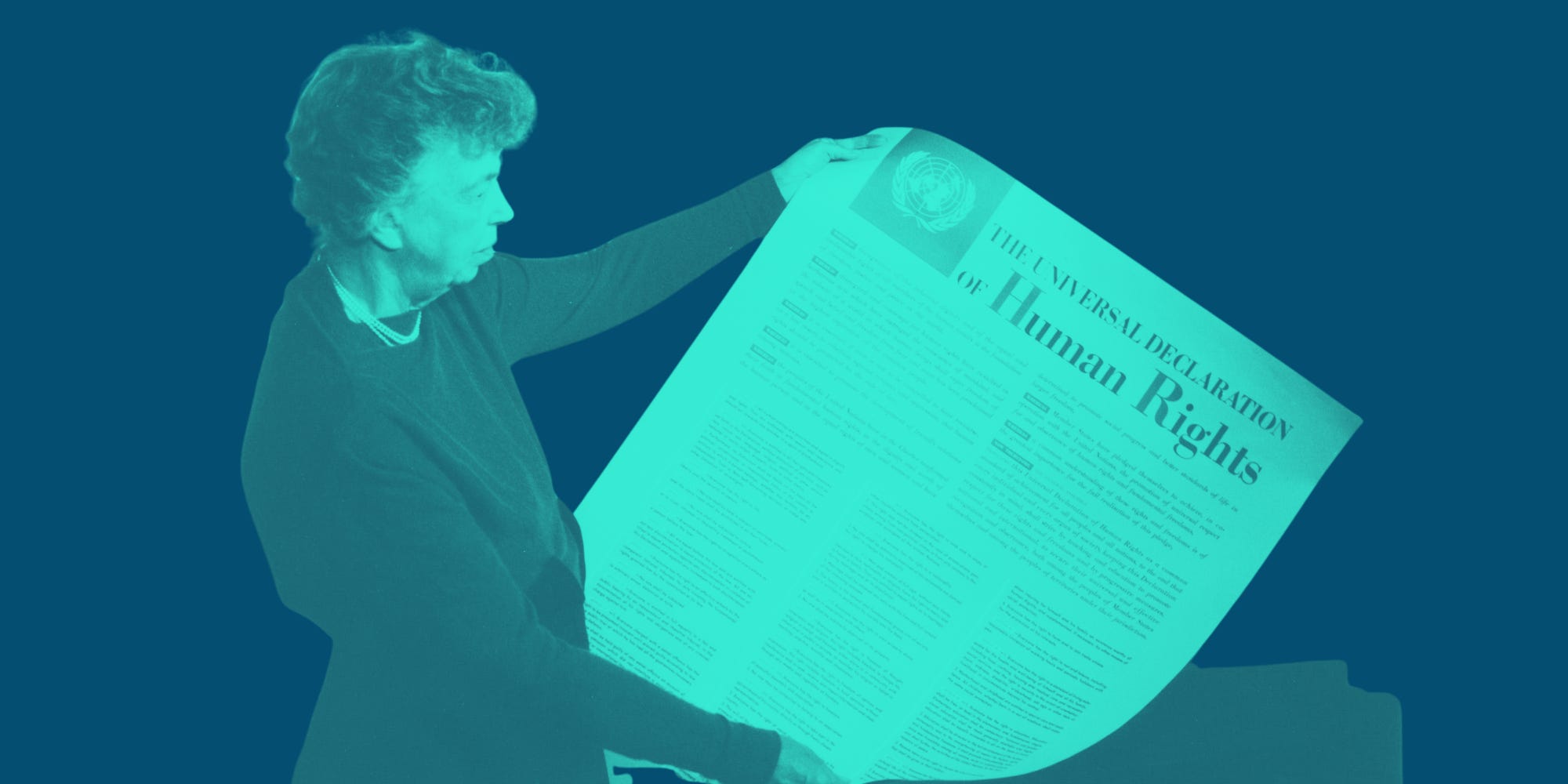
On December 10, 1948, Eleanor Roosevelt stood before the United Nations chamber in Paris to unveil a remarkable achievement: the Universal Declaration of Human Rights. The document enshrined the right to “seek, receive and impart information and ideas through any media and regardless of frontiers.”
That core principle was fiercely resisted by the Soviet bloc, which insisted that states should be obliged to punish hate speech and false information. On the eve of the adoption of the UDHR, Roosevelt pointedly commented on late Soviet attempts to amend the already agreed-upon Declaration:
The Soviet amendment…is obviously a very restrictive statement of the right to freedom of opinion and expression. It sets up standards which would enable any state practically to deny all freedom of opinion and expression without violating the article.
Roosevelt insisted on a robust protection of free speech because she understood that free expression was not a Western luxury but the safeguard of every other liberty enshrined in the UDHR.
Seventy-six years later, the United States is preparing to mark Human Rights Day with a decidedly more mixed message. According to new State Department instructions, U.S. embassies will now be asked to categorize arrests or “official investigations or warnings for speech” as human rights violations.
Indeed, it is becoming increasingly apparent that authoritarian states are not the only perpetrators of mass censorship efforts. Many democracies, including several in Europe, have adopted laws that criminalize online hate speech or impose expansive duties on platforms to police content.
Washington is right to call attention to the idea that suppressing controversial speech—whether through criminal probes, online “safety” laws, or vague prohibitions on extremism—is incompatible with human dignity and democratic rights.
But this stance is only useful if it’s coherent. And today, America risks undermining its message at the very moment the world needs clarity.
For more than a century, the United States has been the world’s most consequential—however imperfect—champion of freedom of expression. During the Cold War, American shortwave broadcasts carried uncensored news past the Iron Curtain in dozens of languages. Václav Havel later recalled how Radio Free Europe and Voice of America “informed us truthfully of events around the world and in our country as well,” helping sow the seeds of the 1989 revolutions.
Beyond broadcasting uncensored news and supporting dissidents abroad, the United States also built a constitutional architecture at home that became the global benchmark for free expression. Over the twentieth century, the Supreme Court forged principles that prohibited government from punishing speech based on viewpoint, protected criticism of public officials as indispensable to democratic accountability—as affirmed in New York Times v. Sullivan—and rejected the idea that citizens must obtain permission before criticizing their leaders.
In the digital age, Congress extended this commitment through Section 230 and other intermediary-liability protections, which ensured that online platforms empowered individuals to speak rather than function as instruments of state control. No other nation has articulated such a consistent, liberty-expanding vision of free expression
But the effort to champion these principles abroad is now in retreat. In recent years, the U.S. has scaled back funding for institutions that promote free speech ideals and provide independent reporting in societies where censorship is the norm. Radio Free Europe/Radio Liberty, Radio Free Asia, and Voice of America—all vital tools for reaching people in closed societies—have faced cuts or political interference.
Meanwhile, authoritarian rivals have grown bolder. China and Russia, having perfected sophisticated systems of digital censorship at home, now export those models through international bodies and regional alliances. Their approach rejects and inverts the very premise Roosevelt fought for: that human rights limit state power.
Foreign agent laws offer one of the clearest examples of this authoritarian playbook. Russia’s 2012 law marked a watershed: it allowed authorities to brand NGOs, journalists, academics, and cultural figures as “foreign agents” based on opaque criteria and without any need to prove foreign funding or direction. The designation triggers crippling reporting requirements, social stigma, and the constant threat of criminal prosecution.
What began as a tool to marginalize independent civil society has now metastasized. Georgia, Kyrgyzstan, and Hungary (to mention just a few countries) have all adopted versions of this model, transforming transparency rules into instruments of political control. These laws institutionalize the very logic Roosevelt warned against: the presumption that dissent is a security threat rather than an integral part of public life.
The global free-speech recession is even more alarming because it is no longer driven solely by authoritarian regimes. Some of the world’s largest democracies—countries whose constitutional traditions and geopolitical weight shape global norms—are now eroding core expressive freedoms.
India has repeatedly shut down the internet and pressured tech companies to censor social media platforms and chatbots. Brazil has pursued sweeping judicial orders to suspend platforms and block users accused of spreading “disinformation.” South Africa has enacted legislation against “malicious communication” that is so broad it risks criminalizing ordinary political debate. When influential democracies adopt illiberal speech controls, they legitimize the very censorship models they once helped restrain.
At a time when the U.S. should be championing global free expression, the current administration is doing more harm than good. It is entirely appropriate to criticize allied democracies for overbroad speech restrictions. But such criticism rings hollow while simultaneously narrowing the scope of human rights reporting abroad, deporting noncitizens for speech the government doesn’t like, monitoring foreign visitors’ social media accounts, relentlessly threatening American media outlets with lawsuits and possible revocation of broadcast licenses, and comparing political criticism to treason punishable with death, to mention just a few examples. The result is not simply inconsistency; it is a strategic self-inflicted wound that weakens America’s ability to defend the very values it urges others to uphold.
The issue is not whether Washington should call out flawed policies abroad, nor whether America must attain perfection at home before doing so. The record since the adoption of the UDHR shows that U.S. leadership on free expression has been a driving force behind an unprecedented global Golden Age of free speech—an authority that carries the greatest weight when grounded in principle rather than grievance-fueled partisanship.
That ideal remains indispensable but also vulnerable. The Golden Age has now been in retreat for close to two decades, with calamitous consequences for democracy and freedom around the globe. If the United States walks away from its post-war role as the loudest defender of free expression, the vacuum will not remain empty. It will be filled by governments that treat speech as a threat to be managed rather than a right to be protected, and the free speech recession will only deepen.
Human Rights Day offers an opportunity to remember that free expression has been one of America’s most persuasive forms of diplomacy. Roosevelt knew that the power of an idea—broadcast by radio, carried in samizdat, or shared online—can outlast totalitarian regimes and pierce Iron Curtains. If the United States wants to deter censorship abroad, it must model the confidence in speech it urges others to show.
The world is watching not only what Washington condemns, but whether it lives up to the principles it claims to defend.
Jacob Mchangama is the Executive Director of The Future of Free Speech and a research professor at Vanderbilt University. He is also the author of Free Speech: A History From Socrates to Social Media and The Future of Free Speech: Reversing the Global Decline of Democracy’s Most Essential Freedom (forthcoming with Jeff Kosseff).