


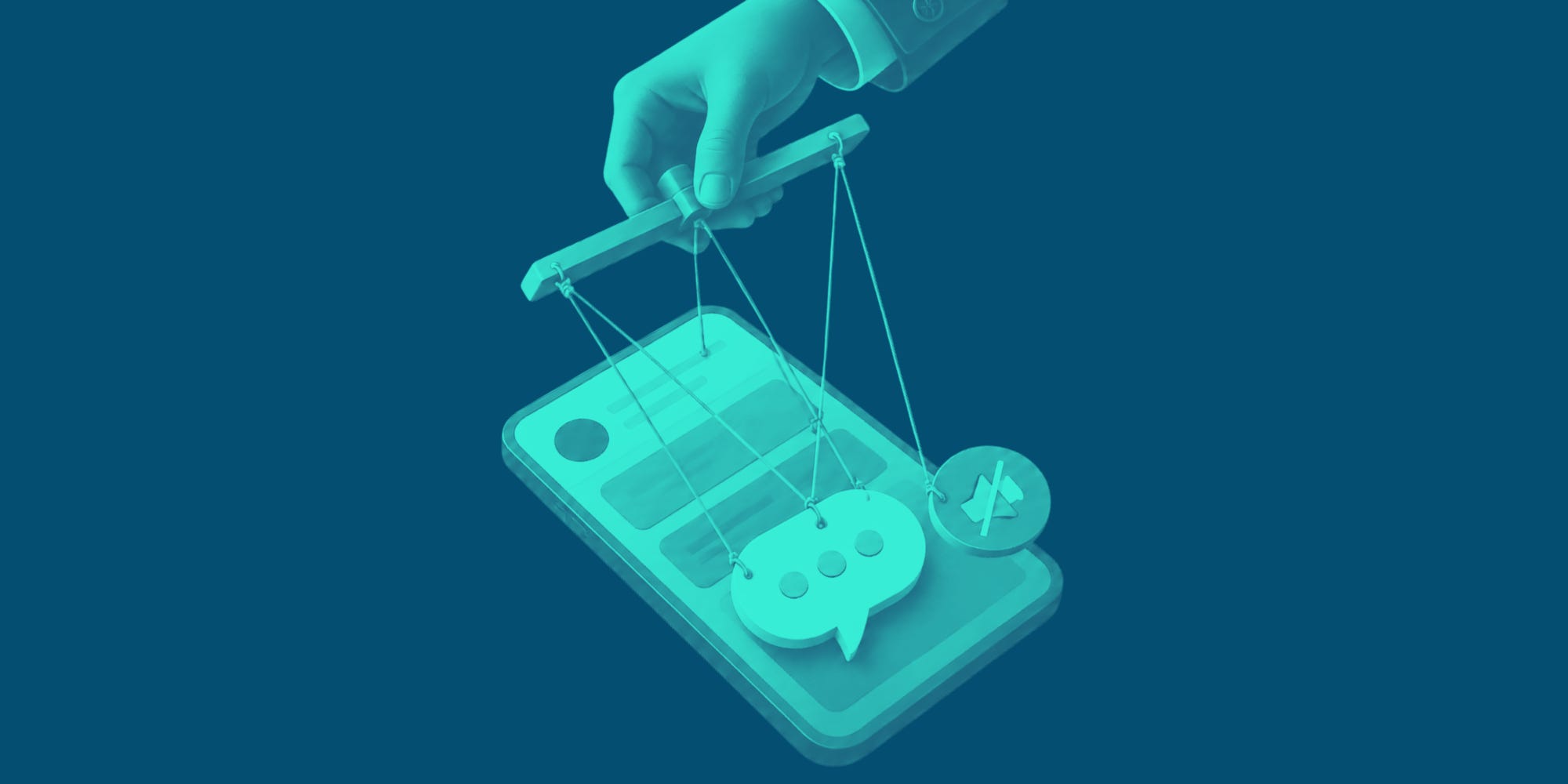
For the past few years, one of the most contentious issues in the online speech world is “jawboning,” or government pressure on companies to censor certain speech. Although jawboning has typically been associated with pressure on social media companies, we have more recently seen serious allegations of jawboning against broadcasters and artificial intelligence providers.
A new bipartisan bill seeks to prevent jawboning in all those contexts and to grant victims of jawboning the right to sue government employees who attempted to censor them. Introduced last week by Sens. Ted Cruz, R-Tex., and Ron Wyden, D-Ore., the Justice Against Weaponized Bureaucratic Overreach to Networked Expression Act (“JAWBONE Act”) defines impermissible government jawboning and provides much-needed transparency to government pressure on speech intermediaries.
The bill would make it illegal for a federal agency or federal employee to “coerce” an online service, AI provider, or broadcaster into changing or removing speech, or suspending or terminating individual users.
Central to the bill is its strong and broad coverage. It defines “coerce” as “to take a harmful, hostile, or unfavorable action, to imply the possibility of taking such action, or to threaten such action.” Among the factors that determine whether coercion exists are:
“the word choice and tone of any relevant communication from the agency, officer, or employee,”
“the existence of any federal regulatory or enforcement authority over the recipient of any relevant communication from the agency, officer, or employee,”
“whether any relevant communication from the agency, officer, or employee referred to adverse consequences to the recipient,”
“whether any relevant communication from the agency, officer, or employee was private or public,”
“whether any relevant communication from the agency, officer, or employee included an affirmative disclaimer that the communication lacked legal force,”
“whether any relevant communication from the agency, officer, or employee included a factual statement without legal force that could be useful to the decision-making of the recipient,”
“whether any relevant communication from the agency, officer, or employee was for the purpose of aiding compliance with existing law,” and
“whether any relevant communication from the agency, officer, or employee led the recipient to act contrary to its own policies.”
The bill’s test for coercion is more detailed than, but similar to, the four-part test for unconstitutional jawboning that the Supreme Court articulated in a 2024 First Amendment case, National Rifle Association v. Vullo. In that opinion, the Court held that to determine whether a government communication constitutes a coercive threat, courts should consider “(1) word choice and tone; (2) the existence of regulatory authority; (3) whether the speech was perceived as a threat; and, perhaps most importantly, (4) whether the speech refers to adverse consequences.”
One might wonder why there is a need for a jawboning bill in light of that strong First Amendment precedent. The JAWBONE Act addresses a major shortcoming in the current legal framework: although the government might have violated the First Amendment, victims of jawboning often lack effective remedies. It is difficult to sue the federal government for constitutional violations. The Supreme Court only allows these suits, known as Bivens claims, in a few specific types of cases and has expressed an unwillingness to extend such lawsuits to First Amendment claims. In other words, even if a plaintiff has strong evidence that the federal government violated their First Amendment rights, there might not be a mechanism to sue for damages.
The JAWBONE Act addresses this problem by creating a private right of action, allowing jawboning victims, state attorneys general, and online services to bring a civil lawsuit against federal agencies or employees for violations of the law. The right of action allows compensatory damages, costs, attorneys’ fees, and equitable relief.
The bill addresses another obstacle to jawboning cases: defendants often move to dismiss for failure to state a claim or lack of standing before any discovery has occurred. Without discovery, the plaintiff may not have alleged enough facts to survive a motion to dismiss. The bill allows the court to grant a limited 30-day discovery period before ruling on the motion to dismiss. This enables the plaintiff to gather sufficient evidence to allow the suit to proceed beyond the dismissal motion.
The bill allows a private right of action not only against federal agencies, but against federal employees in their individual capacities. The JAWBONE Act requires the federal government to indemnify those employees unless the court determines that the employee “acted in a willful and wanton manner in incurring liability.”
In addition to creating a private right of action, the JAWBONE Act would provide much-needed transparency to the federal government’s interactions with social media platforms, AI providers, and broadcasters. It would create a centralized, publicly available portal for federal agencies to report their communications with those companies regarding expression on their platforms.
Jeff Kosseff is a Non-Resident Senior Fellow at The Future of Free Speech and the co-author (with Jacob Mchangama) of the new book The Future of Free Speech: Reversing the Global Decline of Democracy’s Most Essential Freedom (Johns Hopkins University Press, 2026).