


This Week at a Glance 🔎
— 🇺🇸 ABC Enlists Audience in Battle With FCC
— 🇵🇰 Pakistani Activist Sentenced to Life for ‘Provactive Speech’
— 🇮🇳 Telegram Sues Over India Block
— 🏴 Scottish Parliament Restricts Press Access to Legislature
—📱Texas Urges Supreme Court Against Halting Age-Verification Bill
First of All 🇺🇸
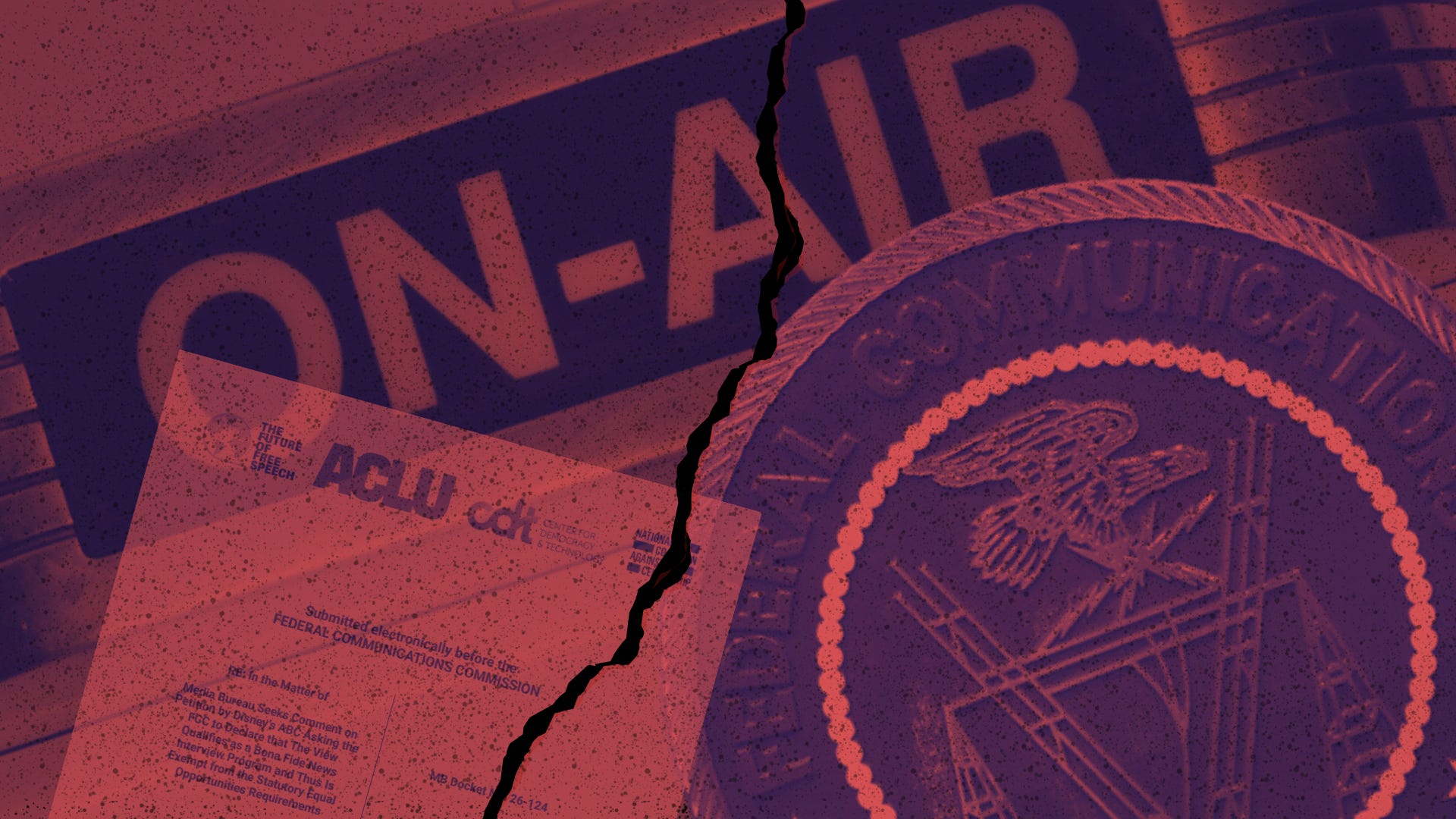
» ABC Enlists Audience in Fight Against FCC Licensing Review
Disney’s local ABC stations aired messages notifying viewers of its ongoing battle with the Trump administration’s Federal Communications Commission over the commission’s early review of their broadcast licenses, which asked them to submit public comments in support.
ABC vs. FCC:
The move comes after the FCC ordered an early license review of ABC-owned television stations in April, a day after Trump pressured the network to fire late-night host Jimmy Kimmel over a controversial monologue, as detailed in a previous Free Flow.
FCC Chairman Brendan Carr insists that the early-renewal order is the result of a separate investigation into diversity, equity, and inclusion practices at Disney, ABC’s parent company.
Details:
The ads urge viewers to contact the FCC by scanning a QR code linking to the agency’s public comment page and align with the FCC’s public comment period to demand that Disney reapply early for its stations’ license renewals.
The public comment period will precede any court battles between Disney and the FCC, and while the actions involving The View and the local stations are separate proceedings, the company has said they involve the same free speech principle.
» Thousands of Americans Submit Comments to FCC on ‘Equal Time’ Rule Inquiry into The View
Over 40,000 public comments have been submitted to the FCC over its inquiry into whether The View should be exempt from the agency’s “equal-time” rule, which requires broadcast stations to provide equal airtime to all legally qualified candidates in a particular race.
Background:
In February, the FCC accused ABC’s The View of violating the equal time rule over Texas Senate candidate James Talarico’s appearance on the show.
The agency opened a request for comment in May on whether the show is a “bona fide news interview program” and is exempt from the rule.
ABC also sent a legal letter accusing the Federal Communications Commission of attempting to threaten broadcasters and limit political discourse, as mentioned in a previous Free Flow.
Our Take: We, alongside the ACLU, Center for Democracy & Technology, and National Coalition Against Censorship, submitted a public comment to the FCC urging it to reaffirm that The View qualifies as a bona fide news program.
“The First Amendment does not permit the government to decide which interview programs qualify as legitimate journalism based on their viewpoints or perceived political leanings,” said Ashkhen Kazaryan, the lead author of the filing. “For 40 years, the FCC has deferred to broadcasters’ good-faith news judgments. Abandoning that principle now would chill political coverage and invite government scrutiny of editorial decisions that the Constitution places beyond the government’s authority.”
» Texas ICE Protesters Sentenced to At Least 50 Years Imprisonment on Terrorism Charges
A group of protesters has been convicted of terrorism charges and received sentences of at least 50 years in prison over a July 4 protest at the Prairieland Immigration and Customs Enforcement detention facility in Alvarado, Texas.
The Protest:
The demonstrators planned to set off fireworks outside the facility for detainees to hear, as an expression of solidarity.
A few protesters separated from the main group and vandalized cars in the parking lot, a guard shack, slashed tires on a government van, and broke a security camera.
The incident comes after the Trump administration designated “Antifa” as a domestic terrorist organization in a September executive order and assigned federal agencies to “investigate,” prosecute, and “disrupt” protesters engaging in “anti-capitalism,” “anti-fascism,” and “anti-Americanism” in a memo days later.
In Court:
The defendants denied ties to antifa, short for “anti-fascist.”
Prosecutors also focused on the cache of guns that several defendants owned and brought to the protest, though all the firearms were legally purchased, and only one person, Benjamin Song, fired a weapon, hitting an officer in the shoulder. He was sentenced to 100 years.
6 protesters were convicted of riot, providing material support to terrorists, and explosive charges, with 5 sentenced to 50 years in prison and one sentenced to 70 years, with an additional conviction of corruptly concealing a document or record.
Several of the defendants, including Elizabeth Soto and her husband, Ines Soto, were not involved in the group that planned to bring firearms; they arrived separately at the protest and left the grounds when facility guards asked. Soto was among those sentenced to 50 years.
» Former Employee Sues EPA for Firing Over Petition Signature
Elin Warn Betanzo, a former employee of the U.S. Environmental Protection Agency (EPA), has filed a lawsuit against the agency, alleging she was fired for signing a petition critical of the Trump administration’s environmental policies.
Details:
Warn Betanzo, a drinking water expert who played a significant role in exposing the Flint water crisis, joined hundreds of EPA employees in July 2025 to sign the “EPA Declaration of Dissent,” a petition to EPA Administrator Lee Zeldin criticizing recent agency policies.
The petition also alleged that the recent policies undermined the EPA’s mission to protect public health and the environment.
Two days later, she and 144 other signatories were suspended despite warnings from the EPA’s own lawyers that retaliation over the petition would likely violate the First Amendment.
Betanzo was the only member removed from the council before the end of her term, a move the agency had not done since at least 2000.
The agency said it had a “zero-tolerance policy for career bureaucrats unlawfully undermining, sabotaging, and undercutting the administration’s agenda.”
Her lawsuit accuses the EPA of violating the First Amendment and Whistleblower Protection Act, among other violations, and asks a judge to reinstate her to the advisory council, clear any disciplinary records related to the petition, award lost pay and damages, and block enforcement of the agency’s “zero tolerance” policy against speech.
» Judge Frees Jordanian National from ICE Custody Amid Political Speech Retaliation Claims
Salah Sarsour, a Jordanian national and lawful permanent resident, was released from Immigration and Customs Enforcement custody after a federal judge found that the evidence supported a reasonable inference that his detention was, at least in part, motivated by his political speech.
Context:
Sarsour, the president of the Islamic Society of Milwaukee, was arrested on March 30 outside his home.
An April 2 statement from the Department of Homeland Security (DHS) claimed that he had previously been convicted in an Israeli military court for attempting to illegally possess weapons and ammunition and for throwing a Molotov cocktail at the homes of members of Israel’s armed forces.
DHS also claimed he made false statements during the immigration process and had ties to terrorist organizations.
Although the DHS argues his original visa application was denied because of his prior convictions, Sarsour entered the U.S. in 1993 and became a lawful permanent resident 5 years later.
In Court:
U.S. District Judge James Hanlon concluded that Sarsour presented evidence that supported a reasonable inference that his pro-Palestine advocacy was “at least a motivating factor” in his detention.
The ruling does not resolve Sarsour’s immigration case or whether he will be deported, but it releases him from custody while his First Amendment case against the government is litigated in court.
Hanlon noted that authorities had known about Sarsour’s Israeli convictions for decades and had reviewed them while allowing Sarsour to maintain his resident status after more than 30 years in the U.S.
The judge noted that while the government argued that foreign policy concerns justified the detention, those interests do not forego First Amendment protections.
The Digital Age 🤖

» Telegram Challenges Block in India
Telegram, a messaging app, has sued Indian authorities over an order blocking its use until June 22 to prevent exam fraud.
Details:
The order, which took effect on June 16, was a response to Telegram channels claiming to have exam copies of a national medical entrance test that was canceled last month.
The test was canceled despite millions having sat for the exam due to allegations of leaked papers.
Telegram’s court filing to the Delhi High Court argued that the order was issued “on the impermissible premise that misuse by a subset of users justifies blocking of an entire platform,” citing constitutional and access-to-information concerns.
The restriction was issued under a provision in India’s IT law that allows the government to block access to internet apps in the “interest of sovereignty and integrity of India.”
India’s Solicitor General Tushar Mehta said the government would counter Telegram’s position in court and that it has repeatedly asked the platform to fix its systems.
» Texas Urges Supreme Court Against Halting Age-Verification Bill
Texas officials have urged the Supreme Court to deny emergency petitions seeking to stop the state’s law requiring app stores to verify users’ ages.
Details:
The emergency petitions were filed by Students Engaged in Advancing Texas (SEAT), a student advocacy organization, and the Computer and Communications Industry Association (CCIA), a tech trade association.
They aim to halt the Texas App Store Accountability Act, which would require app stores to verify all users’ ages and require parental permission for minors under 18 to download apps or make in-app purchases.
In its emergency application, SEAT argued that the law lets government officials regulate online speech under the guise of stopping children from accessing harmful content, and restricts minors’ access to news, community forums, and creative expression platforms.
In a separate emergency appeal, the CCIA warned, “Under SB2420, before a Texan may download the Wall Street Journal— or even a weather app or calculator — he must first verify his age.”
“And any Texan under 18 must link his account to a verified parent’s account (another verification hurdle) and obtain express parental consent for any app download or any in-app purchase — every audiobook, every movie, and so on—without any possibility of blanket consent,” the CCIA added.
A lower court had found that, because the state could not show a compelling interest in restricting every category of speech covered by the act or adequately connect its goals to the law’s mandates, it failed strict scrutiny.
The lower court enjoined the law enforcement before the Fifth Circuit paused the injunction, ruling that the law regulates commercial activity and not speech.
The Brussels Effect: Europe and Beyond 🇪🇺
» Scotland’s Parliament Announces Building Restrictions for Reporters
Scottish officials have designated an area in the Parliament where journalists must remain after First Minister’s Questions (FMQs), restricting access to public spaces where they previously questioned politicians.
Details:
Journalists generally had broad access to the outside of chambers, where they could question or “doorstep” politicians following debates, major announcements, or FMQs.
Now, the media’s movement is restricted to the designated area after FMQs.
The parliamentary bureau said it had made the decision “following feedback from a range of building users and discussions with all parties.”
The Scottish Parliamentary Journalists’ Association (SPJA) said that the change “represents a significant departure from established parliamentary practice.”
“It creates a physical and symbolic barrier between elected representatives and those tasked with holding them to account,” the SPJA added.
Free Speech Recession 🌍
» Australia’s Health Practitioner Regulation Agency Adopts IHRA Definition of Antisemitism
The Australian Health Practitioner Regulation Agency (AHPRA), the country’s regulator of health professionals, has adopted the International Holocaust Remembrance Alliance’s (IHRA) definition of antisemitism, which critics argue blurs the line between antisemitism and legitimate criticism of Israel.
Details:
The definition will be used in the agency’s regulatory work, including investigations of complaints lodged against registered health professionals.
The Australia Palestine Advocacy Network (APAN) argued APHRA’s decision risked silencing political expression about Israel’s actions in Gaza and Lebanon, citing testimony from healthcare workers since October 2023 that revealed “fear of professional consequences for speaking publicly about Gaza and Palestine.”
APHRA Chief Executive Justin Untersteiner said the agency is aware of the potential “weaponization of the notifications process” and will view notifications with a framework.
It will also establish an advisory panel of practitioners to improve the process and “strengthen safeguards.”
» Pakistani Activists Sentenced to Life Imprisonment Over ‘Provocative Speech’
Mahrang Baloch, an activist who has spent years campaigning against enforced disappearances in Balochistan, a Pakistani province, has been sentenced to life in prison over accusations of inciting a mob that fatally attacked a paramilitary soldier.
Details:
Baloch began campaigning after her father was allegedly taken by security service officers in 2009 and found dead two years later. She leads an organization called the Balochistan Unity Committee (BYC).
She was convicted of murder and terrorism alongside Sibghatullah, a fellow activist, after prosecutors claimed the pair had incited a mob at a 2024 protest in Gwadar.
30-40 people struck one of the soldiers’ vehicles with sticks and stones, according to a security official, who said Baloch had given a “very provocative speech.”
The official added that paramilitary soldier Shabbir Ahmed was beaten to death after he was separated from the other soldiers.
An anti-terrorism court in Quetta sentenced the pair to life imprisonment and ordered they pay a fine of 200,000 rupees ($719) to Ahmed’s heirs.
» Bangladesh Journalists Charged Over Reporting on State Minister
Six journalists in Bangladesh have been charged, and one has been jailed over their reporting about the State Minister for Local Government, Rural Development, and Cooperatives, Mir Shahe Alam..
Details:
The complaint, filed by Bogura Press Club Treasurer Tanvir Alam Rimon, accuses journalists, all employees of the Daily Agrajatra Pratidin, of false and defamatory reporting.
The complaint also accused the paper’s acting editor, who was jailed, Md. Rezanur Islam, of trying to extort 2 million taka ($16,400) from Rimon and Alam.
Islam was arrested on June 18, while efforts to arrest the other journalists remain ongoing, according to police.
The State Minister Alam has expressed regret over the arrest and urged others not to pursue action on his behalf.
» Turkey Reverses Order to Shut Down Private University
Turkey’s President Tayyip Erdogan has reversed his decision to close Bilgi University, a private foundation university, following backlash from students and faculty.
Details:
On May 22, Erdogan ordered the university’s closure under a law that allows for private institutions to be closed if “the expected level of education and training… is insufficient.”
Students stayed overnight to protest the closure, and the number of demonstrators reached the hundreds before the order was reversed.
Context:
In September 2025, the state seized Can Holding, the university’s corporate owner, in a criminal investigation into alleged fraud and money laundering, and placed the conglomerate’s companies under the management of the Savings Deposit Insurance Fund.
10 detention orders were also issued, three of which included Bigli principals.
According to Yaman Akdeniz, a professor at the university’s Faculty of Law, no one had heard about Can Holding when it took over the university. “We knew that they were close to the government; they owned many things, and they didn’t interfere with academia.”
Akdeniz added that there is no indictment for the alleged crimes yet, and that “Unofficially, some say this is a way to pressure the family into selling the university.”
Although Erdogan has reversed his order, Akdeniz notes that he doesn’t expect many students and or their families to choose to attend the university next year, and that could mean it has only a few years left.
Ashley Haek is a communications coordinator and research assistant at The Future of Free Speech.
Audrey Campbell is a communications intern at The Future of Free Speech and an international relations major at American University.
Isabella Dail is a communications intern at The Future of Free Speech and a recent graduate from Princeton University with a bachelor’s in philosophy.