


In Part 1, I showed why Fara Dabhoiwala’s claim that Cato’s Letters invented the American free speech tradition is deeply flawed—and that the Levellers advanced all of Cato’s core arguments eight decades earlier.
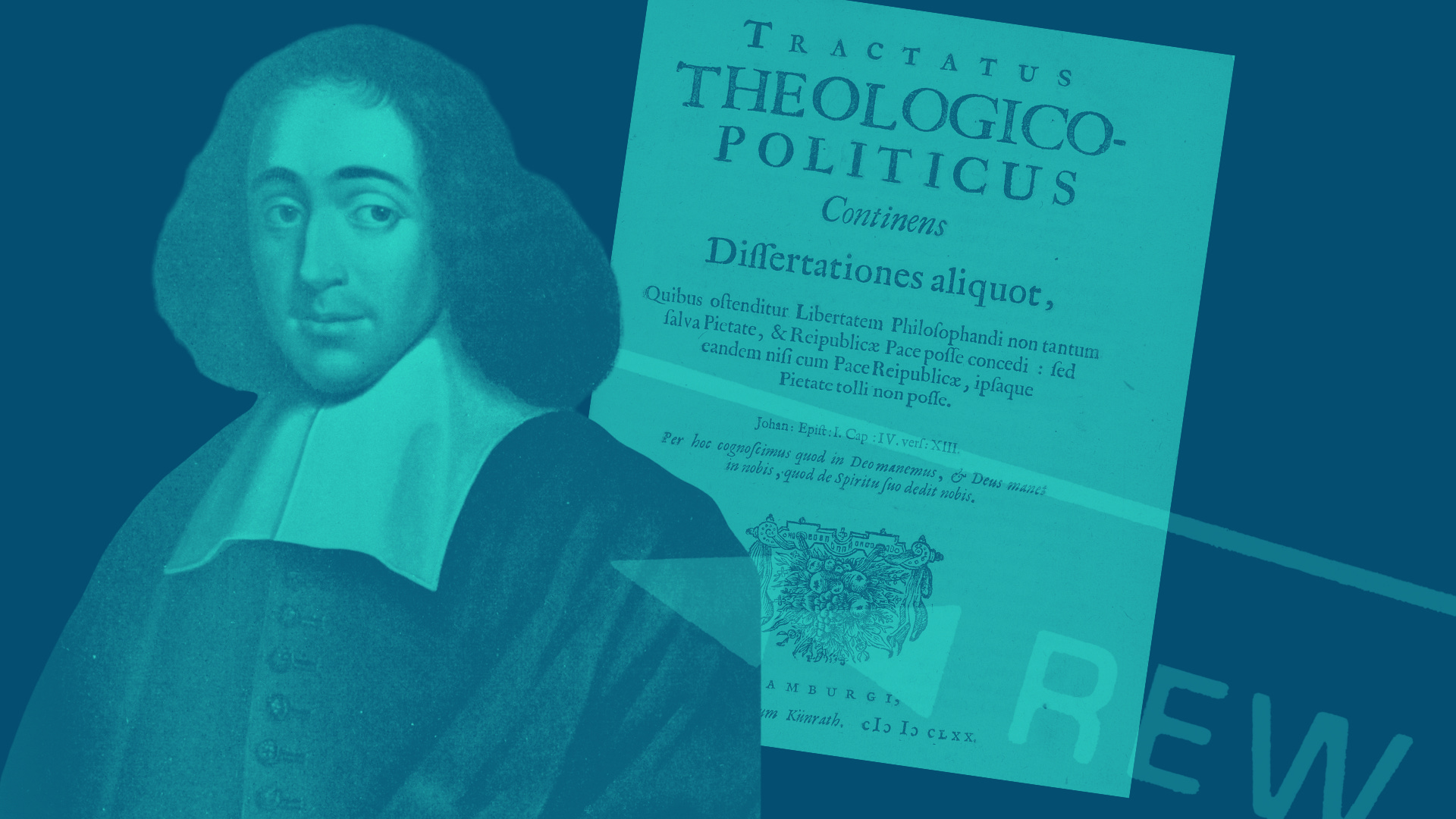
Three decades after the Levellers had been censored and suppressed, another radical, secular, and proto-democratic defense of free speech appeared across the Channel in the Dutch Republic. Although the Theological-Political Treatise (1670) was published anonymously and carried a Hamburg imprint, it was written by the Dutch-Jewish philosopher Baruch Spinoza and published in Amsterdam.
In contrast to Dabhoiwala’s narrative of free speech as the offspring of privilege, Spinoza’s Treatise was shaped by persecution and tragedy. Having already been excommunicated by Amsterdam’s Jewish community for heretical views, Spinoza could not risk publishing under his own name even in Europe’s most liberal and tolerant state at the time, the Dutch Republic. In 1668, two years before the Treatise’s publication, Spinoza’s friend Adriaan Koerbagh was arrested and sentenced to a decade in prison for an irreverent book. The publication made him a target for hardliners in the Reformed Church who pushed the government to narrow the permissible limits of speech. Koerbagh died in prison shortly thereafter, a broken man. Episodes like this helped push Spinoza toward a comprehensive defense of free speech that, contra Dabhoiwala, arguably went beyond Cato’s Letters.
But this is the most Dabhoiwala has to say about Spinoza:
“Even Baruch Spinoza, the most radical 17th-century theorist of libertas philosophandi, stressed this point. Freedom of philosophical speculation was ‘absolutely necessary for progress in science and the liberal arts’, he explained, but no one should speak or act against ‘the laws of the authorities’ or propound seditious doctrines: ‘loyalty to the state is paramount’.”
In a footnote to the quoted paragraph, Dabhoiwala adds: “I disagree with the interpretation of Spinoza as especially radical on this point,” but offers no explanation for why that is. Accordingly, Dabhoiwala clearly suggests that Spinoza proposed a cautious and deferential conception of free speech. But it leaves out so many vital parts of Spinoza’s complex free speech theory, set out in chapter 20 of the Treatise, that it does more to distort and misrepresent than to inform and guide. While much of the early modern world treated free speech as dangerous, Spinoza insisted on libertas philosophandi, the freedom to philosophize, and free expression as necessary preconditions for peace, prosperity, and progress. He famously argued that “in a free state everyone is at liberty to think as he pleases, and to say what he thinks.” And he makes the point in explicitly secular, institutional terms—not as a plea for toleration, but as a condition of political safety: the state is safest when the right of sovereign authorities, “whether in sacred or secular matters … [is] concerned only with actions … [and] everyone is allowed to think what they wish and to say what they think” (a phrase inspired by Tacitus’ The Histories and also referenced by Cato five decades later).
Any regime that violated this “natural right” was “tyrannical.” For Spinoza, “the end and aim of the state, in fact, is Liberty.” In a strikingly modern vein, he linked this vision of liberty to democracy rather than treating democracy as a threat to it. In the Treatise he explained: “I chose to treat democracy in preference to any other form of government because it seemed the most natural one, and the one that comes nearest to giving to each person the freedom that nature gives him”—a direct rebuttal to the idea that unshackled speech runs counter to democracy and at a time where absolutist or strongly centralized monarchist rule was dominant on most parts of the continent.
Centuries before today’s debates about the tension between free speech and toleration in diverse societies, Spinoza argued that freedom of expression is indispensable for peaceful coexistence among people of different faiths and backgrounds. He held up seventeenth-century Amsterdam as an example, “where the fruits of this liberty of thought and opinion are seen in its wonderful increase and testified to by the admiration of every people. In this most flourishing republic and noble city, men of every nation, and creed, and sect live together in the utmost harmony.” He contrasted this with the efforts of hard-liners in the Dutch Reformed Church to impose strict limits on the freedom of religion and thought of dissenters—limits that, according to Spinoza, did not “arise from the anxious study of truth” but rather “from the lust of dominion.”
Against the backdrop of the Early Modern world, Spinoza’s defense of free expression looks incredibly expansive. Even the more liberty-minded American colonies in the late seventeenth century routinely suppressed controversial speech. True, Pennsylvania, Maryland and Rhode Island codified religious toleration. But contrary to Spinoza’s insistence on free speech as a prerequisite for social peace in diverse societies, both Pennsylvania and Maryland punished blasphemous speech and what we today might call “religious hatred” aimed at other sects. Blasphemy, including the denial of the Trinity, was a capital offense in Maryland. Moreover, religious toleration did not translate into political free speech. In Rhode Island, it was a crime to use “words of contempt” against public officials, and the colony even punished open criticism of the assembly’s acts and orders with penalties ranging from fines to whipping and up to a year in jail. William Penn—a onetime prisoner of conscience—instituted prepublication censorship, and Pennsylvania’s 1682 Frame of Government authorized punishment of “scandalous and malicious reporters… defamers and spreaders of false news.” In the second half of the seventeenth century, Europe’s most liberal state after the Dutch Republic, Britain, also used a combination of licensing, sedition and even treason laws to prevent and punish, sometimes with the death penalty, dissent against the Crown and the government. In other words, the world Spinoza was writing into—and the world his ideas would later influence—was one in which law routinely treated criticism of officials and “false news” not as speech to be answered, but as offenses to be suppressed.
On “sedition”: actions, not opinions
It’s true that Spinoza’s free speech doctrine was not all-encompassing. He, too, had his “buts,” since unlimited freedom “would be most baneful.” He put a premium on calm and reasoned debate, distinguishing between criticism of laws grounded in (permissible) “good sense” and (impermissible) sedition—a distinction that can feel frustratingly vague, and therefore open to abuse. It raises the thorny question of who gets to determine what counts as “good sense” and what counts as “sedition.” Yet Spinoza’s account of sedition is also, in a crucial respect, more principled than most early modern theorists—including Cato—because he tries, however imperfectly, to root the boundary in actions rather than opinions.
For Spinoza, “everyone’s loyalty to the state, like their faith in God, can only be known from their works”—a separation of deeds from words that foreshadows the First Amendment’s insistence that speech alone is not sedition. He explicitly states that “a government which denies each person freedom to speak and to communicate what they think, will be a very violent government, whereas a state where everyone is conceded this freedom will be moderate.” The only speech he plainly treats as seditious is holding that “a sovereign power does not have an autonomous right,” and even here it is “subversive not so much because of the judgments and opinions in themselves as because of the actions which such views imply.” Spinoza expert Steven Nadler suggests that a plausible interpretation of where Spinoza draws the line is that criticism of the government’s laws and policies is protected, but that advocating for what today we might call civil disobedience is punishable. As such, Spinoza might have agreed with the US Supreme Court in the infamous WWI era Schenck decision, where anti-draft activists were convicted for distributing leaflets urging resistance to conscription—a decision later eclipsed by Brandenburg v. Ohio, which requires incitement to imminent lawless action likely to produce such outcomes, before speech can be suppressed.
In that sense, Spinoza falls significantly short of modern First Amendment doctrine. But for his time, he is extraordinary: he treats free expression as a precondition of social peace, not a danger to it, and he insists that actions—not words—should do the decisive work when governments claim to be suppressing “sedition.” Paramount loyalty to the state, in his view, does not include surrendering your right to criticize the government or its policies— so long as you actually obey the laws that you want to change.
A presumption against prohibition
Moreover, the flaws introduced by Spinoza’s vagueness are tempered by what is arguably an underlying presumption against prohibition. He does not pretend liberty is cost-free: “Undeniably, there are sometimes some disadvantages in such freedom.” Yet he insists that trying to control everything by law backfires: “Trying to control everything by laws will encourage vices rather than correcting them.” Because some evils invariably prevail against legal coercion, “Things which cannot be prevented must necessarily be allowed, even though they are often harmful.” In other words, even where Spinoza draws lines, his default posture is that speech should remain lawful unless the case for suppression is compelling—because the attempt to legislate away every harm produces worse ones.
Despite Spinoza’s reservations, his expansive view of free speech would undoubtedly have encompassed much of what English common law for centuries treated as “seditious libel,” which could include merely criticizing the actions or policies of ministers and governments. For Spinoza, despite the dangers involved in permitting free expression—in his day, sedition; in ours, Dabhoiwala might say bigotry and disinformation—free speech was essential: “this liberty is absolutely essential to the advancement of the arts and sciences; for they can be cultivated with success only by those with a free and unfettered judgment.” Whatever its dangers, the liberty to think and speak freely was, for him, a condition of human progress.
Spinoza vs. Cato
This is precisely why Dabhoiwala’s attempt to minimize Spinoza’s radicalism in favor of Cato is so odd. It is not at all clear that Cato’s support for free speech goes further than Spinoza’s—there is a strong case that Cato imposes more restrictions on speech than Spinoza, not fewer. Letter No. 62 concedes that “civil government” ought to regulate “natural and absolute liberty” lest it “grow licentious.” It adds that individuals have the right “to think what he will, and act as he thinks, provided he acts not to the Prejudice of another.” That may help explain why Letter No. 32 describes “libels against government” as “always base and unlawful.” Cato even suggests that “a libel is not the less a libel for being true” and that “there are some truths not fit to be told.” Letter No. 32 treats attacks on the head of state as uniquely grave: “when they strike at the person of the prince, the measure of their guilt is complete,” and whoever “vilifies and traduces him” is cast as “an enemy to society and to mankind.” Contrary to Dabhoiwala’s framing, Cato’s Letters arguably embrace a more circumscribed conception of free speech than what Spinoza defends.
Throughout his book, Dabhoiwala portrays First Amendment–style protections as dangerous: they allegedly invite hatred rather than reasoned discussion. By contrast, “European-style” speech regulation—expression confined within the bounds of “reason”—is presented as a saner, more democratic alternative. In short, Dabhoiwala seems to want the reader to choose his Spinoza over his Cato. But Spinoza was not a tame apostle of managed speech. He was a radical who faced real repercussions: he was excommunicated, published anonymously, and wrote in a political climate where heterodox ideas could land you in prison— even within the comparably tolerant Dutch Republic. Spinoza died in 1677, but his writings remained notorious and were widely banned and maligned by Throne and Altar in seventeenth and eighteenth-century Europe.
This matters for a final reason. Dabhoiwala frames robust free speech as an inheritance from privileged English Whigs whose ideas were allegedly “mendacious” from the start. Spinoza is a direct counterexample: a Jewish, secular, democratic, emancipatory thinker who treats liberty of thought and expression as a natural right, and who sees the end and aim of the state as liberty itself. Jonathan Israel has argued that Spinoza was a trailblazer of what he calls the “Radical Enlightenment,” seeking to embed an emancipatory, libertarian, democratic ideology in society. However contested that label, it captures something important: Spinoza’s telos is far more ambitious than Cato’s defense of a more permissive post-1688 settlement—a settlement that stopped well short of democracy or the recognition that sedition depends on actions, not ideas.
I hope to have demonstrated that Dabhoiwala’s What is Free Speech? is an unreliable guide to the history of free speech. Its real purpose is to polemicise against modern First Amendment doctrine. To do so, Dabhoiwala has created a distorted origin story in which the American free speech tradition was invented by two venal hacks, out of self-interest rather than any notion of the common good. But this history depends on showing Cato and its authors in the worst possible light and ignoring earlier, and more radical, contributions to free speech from protagonists who championed democracy, equality, and toleration—the very values that Dabhoiwala claims “free speech absolutism” endangers. The end result is not only bad history, but a silencing of voices who paid a heavy price for advocating the freedom that Dabhoiwala seems to take for granted, even though he depends on it for a living.
Jacob Mchangama is the Executive Director of The Future of Free Speech and a research professor at Vanderbilt University. He is also the author of Free Speech: A History From Socrates to Social Media and The Future of Free Speech: Reversing the Global Decline of Democracy’s Most Essential Freedom (forthcoming with Jeff Kosseff).