


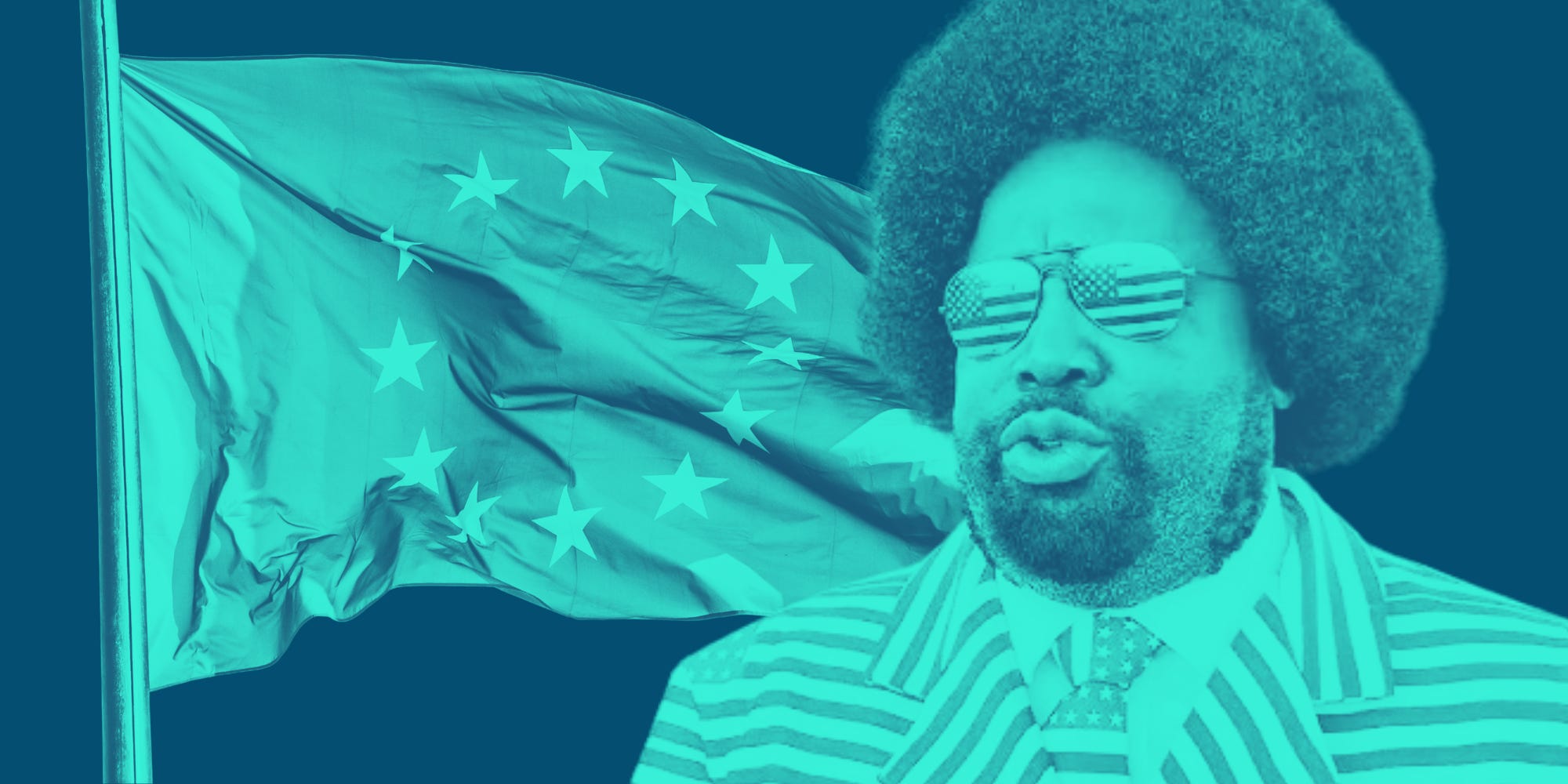
In Ohio, a rapper posted music videos calling officers who raided his home “white supremacists” and worse. Last week, a jury rejected the officers’ $3.9 million lawsuit against him. In Germany, a man was fined for calling a senior politician a “lying piece of [poop emoji].”
The contrast captures something extraordinary about American law: public officials in the United States face far steeper barriers when they try to punish even caustic criticism than in other liberal democracies.
The successful defendant was Joseph Foreman, the rapper known as Afroman, known for the 2000 song, “Because I Got High.” In August 2022, officers searched Foreman’s home under a warrant seeking evidence of kidnapping and drug trafficking, but the investigation resulted in no criminal charges.
Using videos recorded by his wife and home security cameras, Foreman turned his anger into art, creating songs and music videos about the raid, including some pointed language that used names and images of the officers involved.
In an Instagram post, he referred to one of the officers as an “ADAMS KKKOUNTY SHERRIF LIEUTENANT.” Foreman’s narration of the videos included lines such as “Did you have to traumatize my kids? Will you pay me for doing me wrong?” while also making statements such as, “Bring back the money that you stole.”
Under the First Amendment, police officers and other government officials face an incredibly steep climb in convincing a court to punish speakers for even the sharpest criticism. And thanks to a 1964 U.S. Supreme Court opinion, New York Times v. Sullivan, public officials in defamation cases must establish “actual malice,” which means that the defendant either knew that the statement was false or recklessly disregarded its falsity.
Yet several U.S. politicians, including President Trump, commentators, and even Supreme Court Justices Neil Gorsuch and Clarence Thomas, are increasingly questioning whether New York Times v. Sullivan and other robust protections for freedom of speech should continue in light of the immense and novel challenges that we face with online speech.
But Americans who have fallen out of love with the First Amendment’s free speech exceptionalism should consider what might replace it.
Foreman’s victory was not a legal fluke. It reflects a broader American principle: public officials are supposed to endure a degree of ridicule, insult, and even reckless unfairness that many of their counterparts in Europe can more easily punish.
In Germany, for instance, insulting politicians and government officials can result in criminal charges. In 2024, after a 25-year-old student greeted two police officers with “There’s that racist club again,” the Stuttgart Regional Court imposed a fine for the insult. German criminal law provides politicians with heightened protection against insults and defamation, and truth is not a defense.
In 2024, there were 4,500 investigations of such offenses in Germany. Current Chancellor Friedrich Merz and former vice‑chancellor Robert Habeck have each triggered hundreds of criminal investigations against citizens for allegedly insulting them, often over coarse tweets and memes. Merz has gone after critics who called him a ‘racist asshole,’ and in 2024, a man was fined for calling Habeck a “lying piece of [poop emoji]”.
Even without criminal insult and defamation laws, European public officials can use the civil defamation system to impose substantial costs on speech, as the officers attempted to do with Foreman. Last year, the clerk of Fleggburgh Parish Council in England was awarded £20,000 after suing a parish councillor who accused him of dishonesty and threatening behavior in Facebook posts.
And outside of the United States, such attempts may be more likely to succeed, as the defendant often has the burden of proving the truth.
Such fragile protections of free speech would endanger innumerable Americans who think nothing of excoriating their public officials and elected representatives. From memes of Joe Biden as senile to comparisons of ICE-agents as Gestapo goons and South Park’s constant mockery of Donald Trump, all such speech could conceivably be jeopardized should America move in a more European direction.
Afroman’s case demonstrates why the protection of vulgar, offensive, and provocative speech is a virtue, not a vice, in an open democracy where power is derived from the people. This wisdom was clearly recognized by the architect of the First Amendment, James Madison, who held that this provision codified “that right of freely examining public characters and measures, and of free communication among the people thereon, which has ever been justly deemed the only effectual guardian of every other right.”
James Madison and Afroman would seem to have almost nothing in common. One is a distinguished statesman who helped design a constitutional republic in prose of measured precision; the other is an irreverent artist who answered a police raid with profanity, parody, and a camera.
Yet Foreman’s case vindicates Madison’s deepest insight: that freedom depends on denying public officials the power to punish those who hold them up to scorn. The speech may be vulgar, exaggerated, and offensive. That is precisely the point. A right that protects only respectful dissent is no right at all.
Jacob Mchangama is the Executive Director of The Future of Free Speech and a research professor at Vanderbilt University. Jeff Kosseff is a nonresident senior legal fellow at The Future of Free Speech. They are the authors of The Future of Free Speech: Reversing the Global Decline of Democracy’s Most Essential Freedom (forthcoming 2026).