


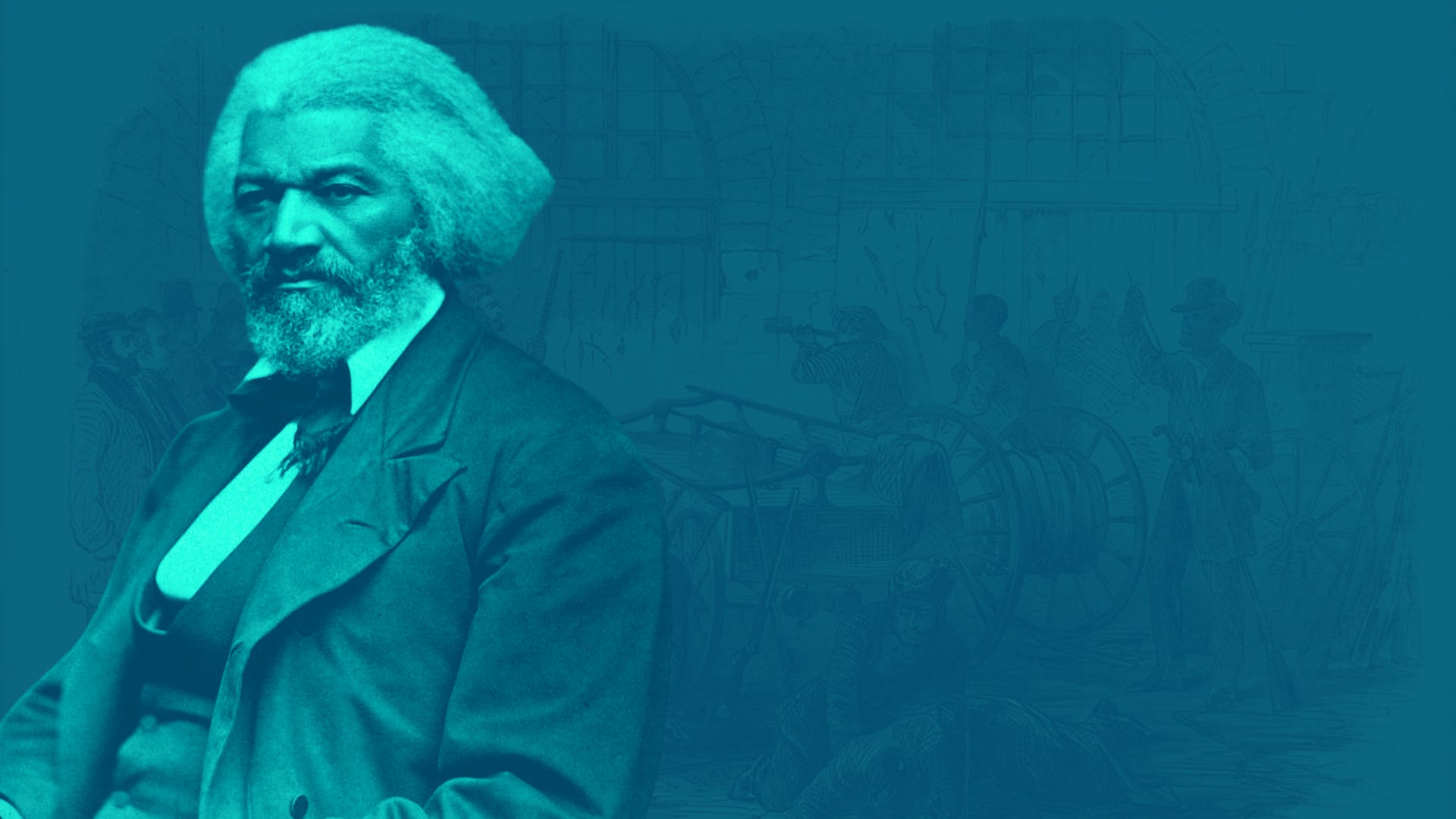
This article was originally published on Jacob Mchangama’s Substack on September 3, 2026.
This is the second in a series on Frederick Douglass’ free speech philosophy, drawn from the Frederick Douglass Free Speech Corpus—a growing collection of close to two hundred speeches, editorials, letters and interviews I’m currently curating. In Part 1, I found that during the Civil War Douglass defended the right to attack Lincoln and cheer for Jefferson Davis, an astonishing position for a man who had given his life to a cause that only Union victory could secure, and that the Confederacy waged all-out war to prevent.
This installment takes up another test—what did Douglass do when what was at stake was not sedition or criticism of the government but lies and attacks aimed at himself? It is a test that has undone many a great champion of free expression, in what I’ve called Milton’s Curse: free speech for me, but not for thee. Douglass spent half a century embroiled in often bitter and deeply personal wars of words. Yet as far as I can tell, he initiated legal action for defamation only once.
Frederick Douglass was a frequent target of vilification and smears—not to mention hostile mobs, stones and rotten eggs. His enemies—and sometimes even erstwhile allies—used the press and the pulpit to counter the growing influence of his oratorical genius and editorial prowess. Douglass’ primary weapon consisted of words—but what to do when opponents turned this weapon against him? Was counterspeech a sufficient remedy, or should legal redress also be an option? What rules—legal or moral—should guide newspaper editors with power to shape public opinion? And as Douglass became an influential speaker, editor and publisher himself, did he practice what he preached?
Douglass the Defamed
“Nigger” and other racial epithets were routinely hurled at Douglass. But far more damaging than crude racist attacks were various allegations of sexual depravity, of lying about his life story, of being a paid anti-American agitator and of being a cowardly co-conspirator in the attack on Harper’s Ferry.
In August 1841, Douglass gave a speech at Nantucket’s Atheneum that made him an immediate sensation in abolitionist circles and launched his career as a peripatetic orator and relentless freedom fighter. William Lloyd Garrison vividly described Douglass’ impact:
“I shall never forget his first speech at the convention—the extraordinary emotion it excited in my own mind—the powerful impression it created upon a crowded auditory … I think I never hated slavery so intensely as at that moment.”
The enthusiastic response to Douglass’ speeches prompted the idea for his first autobiography, “Narrative of the Life of Frederick Douglass, an American Slave” (1845), which in turn transformed Douglass into an international celebrity. But as his fame increased, so did the scrutiny, criticism and hostility he faced.
In late 1845, the Delaware Republican published a letter—“Falsehood Refuted”—from an A.C.C. Thompson who had lived in Maryland and knew the “runaway slave” (Douglass). Thompson insisted that the Narrative was a “catalogue of lies” composed by “some evil designed person or persons” to “excite the indignation of public opinion against the slaveholders of the South”. Thompson also defended Douglass’ previous owners and a brutal overseer named in the Narrative, claiming that he was “intimately acquainted with most of the gentlemen whose characters are so shamefully traduced”.
But Douglass turned Thompson’s damning accusations into a victory. He wrote a sarcastic reply in Garrison’s abolitionist newspaper The Liberator. Douglass begged Thompson “to accept my thanks for his full, free and unsolicited testimony, in regard to my identity”, since the article had “forever” settled the question of whether Douglass had truly been a slave or was a fictitious character of abolitionist propaganda. He continued:
“I am greatly indebted to you, sir, for silencing those truly prejudicial insinuations … You have done a piece of anti-slavery work, which no anti-slaveryman could do.”
His reply also contained the initial contours of a Douglassian ethical framework necessary for press freedom to serve its proper function. Douglass submitted his response to The Liberator expecting the Delaware Republican to refuse him a rejoinder:
“In any country but the United States, I might hope to get a hearing through the columns of the paper in which I was attacked. But this would be inconsistent with American usage and magnanimity. It would be folly to expect such a hearing. They might possibly advertise me as a runaway slave, and share the reward of my apprehension; but on no other condition would they allow my reply a place in their columns.”
To Douglass, the proper response to attacks on reputation and ideas was reciprocal counterspeech. Ideally, the venue of attack would provide the target equal access to respond. When reciprocity was denied, press freedom provided a corrective mechanism. Media pluralism increased the chances that a fair-minded newspaper would give voice to those denied a right of reply elsewhere.
The Poison and Its Antidote
Douglass would get plenty of chances to wrestle with the functioning of this framework during his extensive stay in Great Britain and Ireland from 1845–47, where he thundered against slavery and its apologists.
Douglass repeatedly attacked the recently established Free Church of Scotland for its fundraising efforts among Presbyterian slaveholders in the American South. Douglass popularized the slogan “Send Back the Money” among Scots outraged that their church was soliciting funds from the “man-stealing, cradle-robbing, and woman-whipping monster[s]” whom Douglass vividly portrayed in his speeches.
The Northern Warder, a Free Church-friendly newspaper, fought back against Douglass’ moral crusade. It accused Douglass and fellow critics of being “foul-mouthed clamourers” and “hired bravoes from the ranks of the American abolitionists” who spread “impieties” and “falsehood and slander” against the Free Church and its ministers.
In his speech “Charges and Defense of the Free Church,” delivered in Dundee on March 10, 1846, Douglass told the audience that he had fully expected a “desperate” attempt to counter his message through “the grossest misrepresentations and the darkest insinuations”. He would not have “uttered a single word of complaint” if the Northern Warder had resorted to such measures in a free and open contest. But instead, he asserted, the editor “assailed our character, impeached our motives, perverted our arguments, and peremptorily refused to permit us a single word of reply”.
Douglass then expanded on his previous press ethics sketch:
“In America, and I believe in this country, it is understood as being but common fairness, when either a single individual or a body of individuals are attacked in their opinions or conduct in the columns of a newspaper, that he or they have an opportunity of reply through the same columns, so that the cup containing the poison, or supposed poison, may also contain its antidote. This in America is established etiquette; it is also common fairness and common justice. It is only where this etiquette is established in a community that it can be said to have any of the advantages of a public press, that it becomes the palladium of liberty as well as of purity. But let the opposite principle prevail, and it is a curse rather than a blessing. No man is safe. He may be pierced through with a thousand poisoned weapons, and be totally without the means of defence or redress. An adroit editor may keep within the letter of the law and break its spirit in every line. Such is the present case. We have not been allowed a single word of reply.”
Note that just months earlier Douglass had written that in America it would be “folly” to expect a right to reply in the same newspaper where he was attacked. Now he described the right of reply as an “established etiquette” in the U.S. He may simply have meant that reciprocity in a pro-slavery Southern newspaper was futile for a runaway slave (after all, most Southern states strictly prohibited abolitionist writings), and that the established etiquette operated with a dividing line based on color.
Whatever the reason for this seeming discrepancy, the quoted passage showed Douglass’ keen awareness that the twin freedoms of the press and speech functioned differently in practice. Press freedom was exercised by the few who had the means to acquire and operate a printing press, providing editors and publishers outsized power to shape public opinion. Restraining this concentration of power demanded responsibility and a commitment to ethical standards, preventing the press from perverting the principles which it was meant to serve. As such, Douglass clearly acknowledged that words—however indispensable for realizing universal human freedom—could also be weaponized to frustrate these ideals and harm those without access to the reach that print provided.
But crucially, Douglass’ primary remedy for the violation of press ethics was not a resort to the law, but rather a reliance on a pluralistic and decentralized press and active civil society. When the Northern Warder refused Douglass a right of reply, the Dundee Courier wrote a detailed article rebutting the claims of the Northern Warder and supporting Douglass, who in turn praised the Courier’s editor for “expos[ing] the sophistries and denounc[ing] the base insinuations”. The combination of the Courier’s coverage and his speech at the raucous meeting in Dundee “was sufficient answer to all the Warder’s indirect slander”.
The New-York Tribune also republished a Douglass article from the Liberator to counter coverage in hostile New York newspapers accusing him of being a “glib-tongued scoundrel” who was “running a muck in greedy-eared Britain against America, its people, its institutions, and even against its peace.” In a private letter thanking the Tribune’s editor, Douglass wrote: “Of the low and vulgar epithets applied to me by the Express, very little need be said. I am used to them. Their force is lost upon me, in the frequency of their application.” What really mattered to him was the opportunity to explain to the readers that “the best friend of a nation is he who most faithfully rebukes her for her sins—and he her worst enemy who, under the specious and popular garb of patriotism, seeks to excuse, palliate or defend them.”
After Douglass spoke at a temperance convention in London, Reverend Samuel Hanson Cox wrote an article in the New-York Evangelist accusing Douglass of being a paid “agitator” who “denounce[d] America” as part of an abolitionist plot to “re-kindle, on both sides of the Atlantic, the flames of national exasperation and war.” Douglass once again relied on the Liberator to respond.
Douglass conceded that answering every hostile accusation displayed “a ridiculous sensibility to the good or evil opinions of men” and wasted precious “thought, time and strength,” particularly when the attacks came from “those who hate me.” But a rebuttal was required when it involved defending “great and vital principles, the vindication of which is essential to the triumph of righteousness throughout the world”.
The Limits of Counterspeech
Soon the limits of Douglass’ commitment to counterspeech would be severely tested. His criticism of the Free Church had caused many Presbyterians to rebel and join the growing chorus of “Send Back the Money”. When Douglass traveled to Belfast to persuade local Presbyterians to demand the return of slavers’ money, Free Church supporters decided to fight back and fight ugly. They cleverly appropriated the viral abolitionist campaign with leaflets shouting “Send Back the Nigger”. But that was not all: the Irish-born American Free Church supporter Thomas Smyth circulated a rumor that Douglass had visited a brothel in Manchester. This was a highly damaging attack on Douglass’ character, calculated to invoke racist stereotypes and blacken his reputation as a person worthy of addressing white Christians as their equal. Douglass confessed that his “spirit was marred” by this “malignant slander”, and he instructed solicitors to initiate legal action against Smyth for defamation. Unable to substantiate his statements, Smyth felt compelled to write a letter expressing his “sincere regret” for the “unfounded” allegations. Douglass accepted the retraction and apology and insisted that the letter should first be published in Belfast, where Smyth had spread the falsehood.
Douglass had finally found the limits of free speech. Racial epithets and character assassination directed at his public life and opinions should be confronted in the court of public opinion. False and highly damaging allegations of fact directed at his private life might justify escalation to courts of law unless retracted. This was hardly a case of egregious hypocrisy. In fact, Douglass might have won a defamation lawsuit against Smyth even under the exacting standards of modern First Amendment doctrine.
From the sources I have identified, it appears that Smyth was the first and last person Douglass ever took legal steps against for defamation, despite a career that continued for almost five decades after Smyth’s retraction. This conclusion is consistent with Douglass biographer John Muller, who in 2022 wrote that he had “not yet come across a case where Frederick Douglass, Sr. filed suit against any journalist or newspaper.”
A Press of His Own
Despite the many attacks on his person, Douglass concluded that his British tour and the attention the controversies generated for him and his cause had been a net benefit. In My Bondage and My Freedom (1855), Douglass wrote that he was often “more indebted to my enemies than to my own skill” since a “man is sometimes made great, by the greatness of the abuse”. But the path to greatness depended almost wholly on having a forum and a receptive audience for counterspeech. This experience convinced Douglass that he needed a printing press of his own:
“a tolerably well conducted press, in the hands of persons of the despised race … would prove a most powerful means of removing prejudice, and of awakening an interest in them”.
Douglass’ entrepreneurial spirit was not appreciated by his backers among white American abolitionists, whose usual admiration turned to condescending dismissal:
“My American friends looked at me with astonishment! ‘A wood-sawyer’ offering himself to the public as an editor! A slave, brought up in the very depths of ignorance, assuming to instruct the highly civilized people of the north in the principles of liberty, justice, and humanity!”
With money from British supporters, Douglass overcame his self-doubt and defied the naysayers by launching The North Star in 1847. As editor and publisher, he was no longer reliant on the goodwill of other gatekeepers when spreading his abolitionist gospel in print. Douglass was now a gatekeeper and responsible for ensuring that The North Star complied with the demanding ethical framework he so frequently lambasted other publishers for violating.
The Editor on Trial
In 1849, The North Star became the venue for a heated and factional discussion among abolitionists divided on the issue of whether the Constitution was an instrument of slavery or a roadmap for emancipation.
Douglass promised to keep the North Star open to all sides of the argument and to be guided solely by the pursuit of truth: “The only truly consistent man is he who will, for the sake of being right today, contradict what he said wrong yesterday.”
These debates—especially with his friend and later financial supporter Gerrit Smith—helped persuade Douglass to abandon the Garrisonian view of the Constitution as inherently proslavery. The reversal caused a bitter rupture with his former allies and sparked an acrimonious war of words. In the following years Garrison spread rumors that Douglass was having an affair with his white collaborator Julia Griffiths, who lived with Douglass and his wife. Much like the Smyth rumors in Belfast, these charges were aimed squarely at Douglass’s private life rather than his ideas. This raised a delicate strategic question: When would publicly answering internecine attacks do more harm to their common cause than the attacks themselves? Despite the rumors’ malicious nature, Douglass met them with furious denials from his pen and press, or strategic silence, rather than legal threats.
Douglass soon faced another difficult test of his own editorial principles. Following a dispute over the proposal to distribute Bibles among enslaved people, he published a sharply personal attack on Henry Highland Garnet, who was preparing to tour Britain. Douglass questioned Garnet’s commitment to moral abolitionism, portrayed him as an advocate of violence and warned British supporters that Garnet represented only himself. Garnet replied that Douglass had “slandered and traduced” him and attempted to discredit his character before an audience important to them both. He further alleged that Douglass had previously withheld one of his letters because its opinions were unwelcome—the very charge Douglass had leveled at the Northern Warder in Dundee. He also portrayed Douglass as hostile to and jealous of other abolitionists whose prominence might threaten his own standing and fame. Yet Garnet acknowledged that Douglass had now given him “an opportunity to speak for myself, through the same medium.” Douglass honored that promise, printing the hostile reply in full under the headline “Calling Him Out, and He Comes.” Douglass allowed Garnet to pour his antidote into the same cup that had contained Douglass’ poison.
The North Star also served as the first line of defense when Douglass was on the receiving end of attacks from other newspapers which didn’t share the same ethical commitment to reciprocity as Douglass. In 1850, Douglass was physically attacked while walking through New York with white friends, including women. One press account falsely portrayed him as deliberately provoking the public by walking down Broadway with two white women on his arms, and claimed that the women subsequently placed themselves under the protection of his assailants. According to Douglass’ account, a group of men surrounded the party, shouted “coarse and filthy language,” struck the women and attacked him multiple times.
In “At Home Again,” Douglass connected the assault to a press campaign that had made him a target:
“Having been, during the past few weeks, the special object of attack, marked out by a corrupt and fiendish Press, for assassination, the victim of a continuous train of almost unprecedented abuse—harassed and dogged from day to day by the furious blood-hounds of American Slavery—I should be something more than a Stoic, if I did not feel and acknowledge a sense of profound gratitude … that I am again permitted safely to occupy my editorial chair.”
Douglass corrected the false particulars but refused to retreat from the principle underlying his conduct. His real “crime,” he wrote, was treating white companions as equals and reducing his belief in human brotherhood to practice: “Not an inch will I retreat—not one jot of zeal will I abate—not one word will I retract.”
Truth and Falsehood at Harper’s Ferry
In 1859, a group of armed abolitionists led by John Brown attacked the federal armory at Harper’s Ferry, hoping to capture weapons and ammunition for a slave rebellion. Brown’s plan failed; many of his men were killed, and Brown was wounded and captured. The fallout of Harper’s Ferry also ensnared Douglass. Newspaper and telegraphic reports implicated him in the raid and attributed to the captured raider John Cook the allegation that Douglass had promised to participate, only to flee when the decisive moment arrived. Federal marshals were dispatched to arrest Douglass as an accomplice. With lawmen closing in, Douglass narrowly avoided arrest and a likely death sentence in slaveholding Virginia by escaping to Canada and from there to Britain.
Douglass mocked the telegraph as “the swiftest of liars” when placed in the hands of the slave power. But his public response carefully distinguished between an insult and a damaging allegation of fact. Cook might call him a coward: “I have not one word to say in defense or vindication of my character for courage.” What Douglass categorically denied was that he had ever promised to take part in the raid.
Nor did he accept that defending his reputation obliged him to disclose potentially incriminating details about Brown or expose other abolitionists to prosecution. Moreover, Douglass would continue to “write, speak, publish, organize, combine, and even … conspire against Slavery” when success appeared possible.
Douglass confronted a subtler version of the same allegation when the pacifist Elihu Burritt accused him of advocating bloodshed, deserting Brown by leaving him to the gallows and fleeing to England. Burritt’s account may have contained individual facts that were technically correct: Douglass had met Brown; he had left the United States; and Brown had been captured and executed.
But to Douglass, press ethics demanded more than avoiding literally false sentences. A writer could arrange “a simple truth” to accomplish “all the malign purposes of a positive untruth.” Biased omission and insinuation could “state a fact, as to convey a complete misrepresentation of its natural import”. Yet once again, his preferred remedy was a reciprocal right of reply in the pages where the untruths had been printed.
The legal aftermath of Harper’s Ferry also provides another rare indication of where Douglass placed the limits of counterspeech, although it may do more to blur than to clarify any Douglassian doctrine. His friend Gerrit Smith suffered a severe mental collapse after the raid. The Chicago Tribune subsequently implied that Smith had feigned insanity to avoid prosecution for supporting Brown. Smith demanded an apology and, when the newspaper refused, brought a $50,000 libel action. In a private letter to Smith, Douglass supported taking legal action against “an accusation of the most damaging kind” for which its editors should “retract or suffer.” The case ended with the Tribune publicly acknowledging that Smith’s illness had been genuine.
The Smith affair complicates any sharp distinction between attacks on public and private life. Smyth’s brothel rumor concerned Douglass’ private sexual conduct, whereas the Tribune’s allegation concerned Smith’s actions following an event of enormous public importance. Yet Douglass pursued legal redress against Smyth and endorsed Smith’s libel lawsuit. Still, the Smyth vs. Smith cases are not necessarily comparable. Douglass’ support for Smith was expressed in a private letter to a distressed friend and benefactor and may not have reflected the redress Douglass thought appropriate if he were on the receiving end. After all, he was the target of significantly more damaging accusations related to the same incident and responded in print rather than in the courts.
The Weight of the Evidence
The willingness to be corrected did not fade with age. In 1882 Douglass wrote a letter to Robert C. Winthrop Jr. apologizing for an unflattering and misleading portrayal of Winthrop’s father in Douglass’ third autobiography Life and Times. Douglass promised to “redress this wrong” in future editions, a promise he kept.
Nine years later, an older Frederick Douglass reflected on his combative spirit:
“When I was a younger man than now … I thought it my duty to contradict all the falsehoods told in respect to my conduct; but I soon found that if I did so I would have little time to do anything else. I therefore concluded to leave many of them to time and events.”
This was more a rule of economy than a retreat from counterspeech. Douglass had learned to distinguish falsehoods that threatened important principles if left unanswered from those whose rebuttal would merely distract him from advancing those principles.
When it comes to what remedies Douglass thought proper for redress, the scale of the evidence is overwhelmingly one-sided. Against the Smyth and Smith cases stand countless speeches, letters and editorials answering his critics with facts and arguments. As an editor, he repeatedly opened his own columns to opposing views, including attacks directed against himself. Even when he failed to live up to his professed editorial ideals, as both Garnet and Winthrop Jr. alleged, Douglass ultimately allowed his accuser to answer in his own columns or acknowledged his error and corrected the record. Add to this several examples of Douglass defending other Black journalists and editors when they faced legal jeopardy for their writings. In one instance, Douglass offered the then-considerable sum of $300 in security for John W. Cromwell—editor of the People’s Advocate—who was charged with criminal libel.
As David Blight shows, Douglass was proud, often hypersensitive to criticism and not above vicious personal counterattack, so the temptation to settle scores in court must have been considerable. That he seems to have instructed lawyers only once in response to defamatory statements suggests he meant what he said about answering attacks in print: rebuttal was owed to “great and vital principles,” not merely to his own wounded pride.
Two things underwrote Douglass’ conviction that the law should protect the pen rather than restrain it: an extraordinary confidence in counterspeech, and a demanding conception of what press freedom required. A newspaper worthy of being called the “palladium of liberty” did not protect readers from controversy. It enabled accusations to be answered, exposed its own claims to adversarial testing and gave truth a chance to prevail over falsehood. Douglass did not merely preach that ideal. Across more than half a century of vilification, he practiced it with a record that—if not unblemished—was impressively consistent.
More than 130 years after his death, Douglass still has something to teach the thin-skinned who want free speech for themselves but not for their critics. It has become all too common for politicians and public figures to sue or threaten legal action over attacks that Douglass would have ignored or answered with facts and arguments. Recent examples include Donald Trump’s defamation suits against the media, German Chancellor Friedrich Merz’s many criminal complaints against online critics over “insults”, free-speech advocate Matt Taibbi’s dismissed lawsuit against the author of a critical book, Gavin Newsom’s $787 million defamation lawsuit against Fox News, and J.K. Rowling’s offer to bankroll libel actions against Amnesty International over its characterization of gender-critical campaigners. It’s a testament to Douglass’ enduring legacy that even in 2026, a culture of free speech infused with his principles would strengthen our ability to speak freely as well as our commitment to truth, integrity, and dialogue.
Jacob Mchangama is the founder and CEO of The Future of Free Speech and a research professor at Vanderbilt University. He is also the author of Free Speech: A History From Socrates to Social Media and The Future of Free Speech: Reversing the Global Decline of Democracy’s Most Essential Freedom (with Jeff Kosseff).